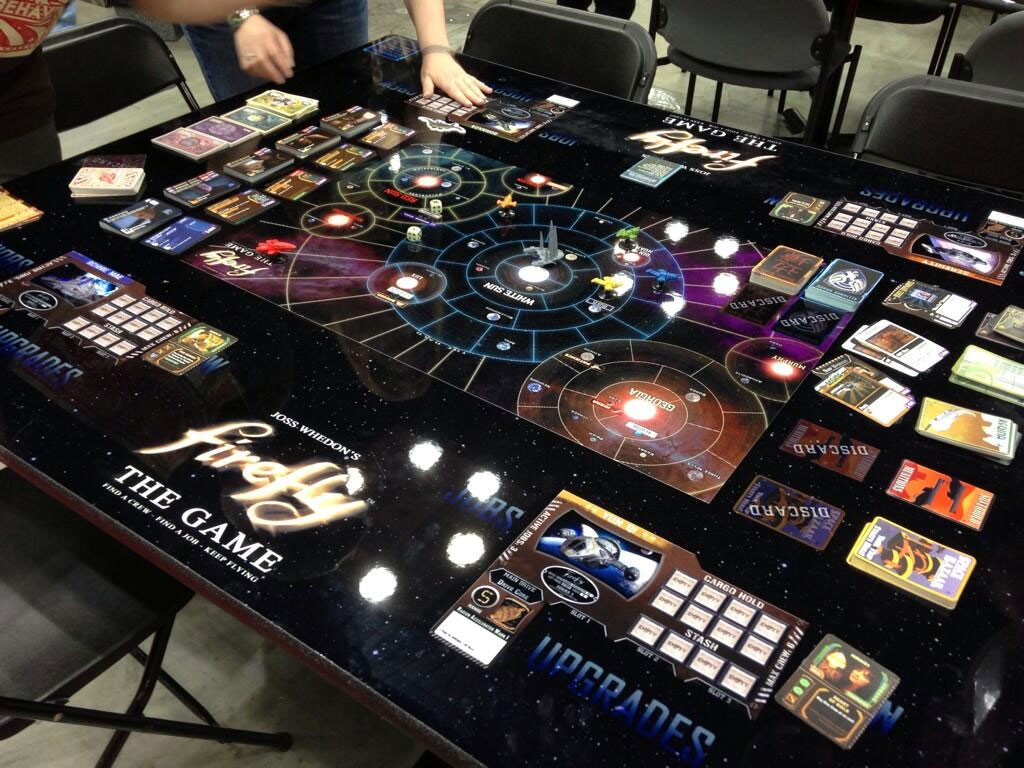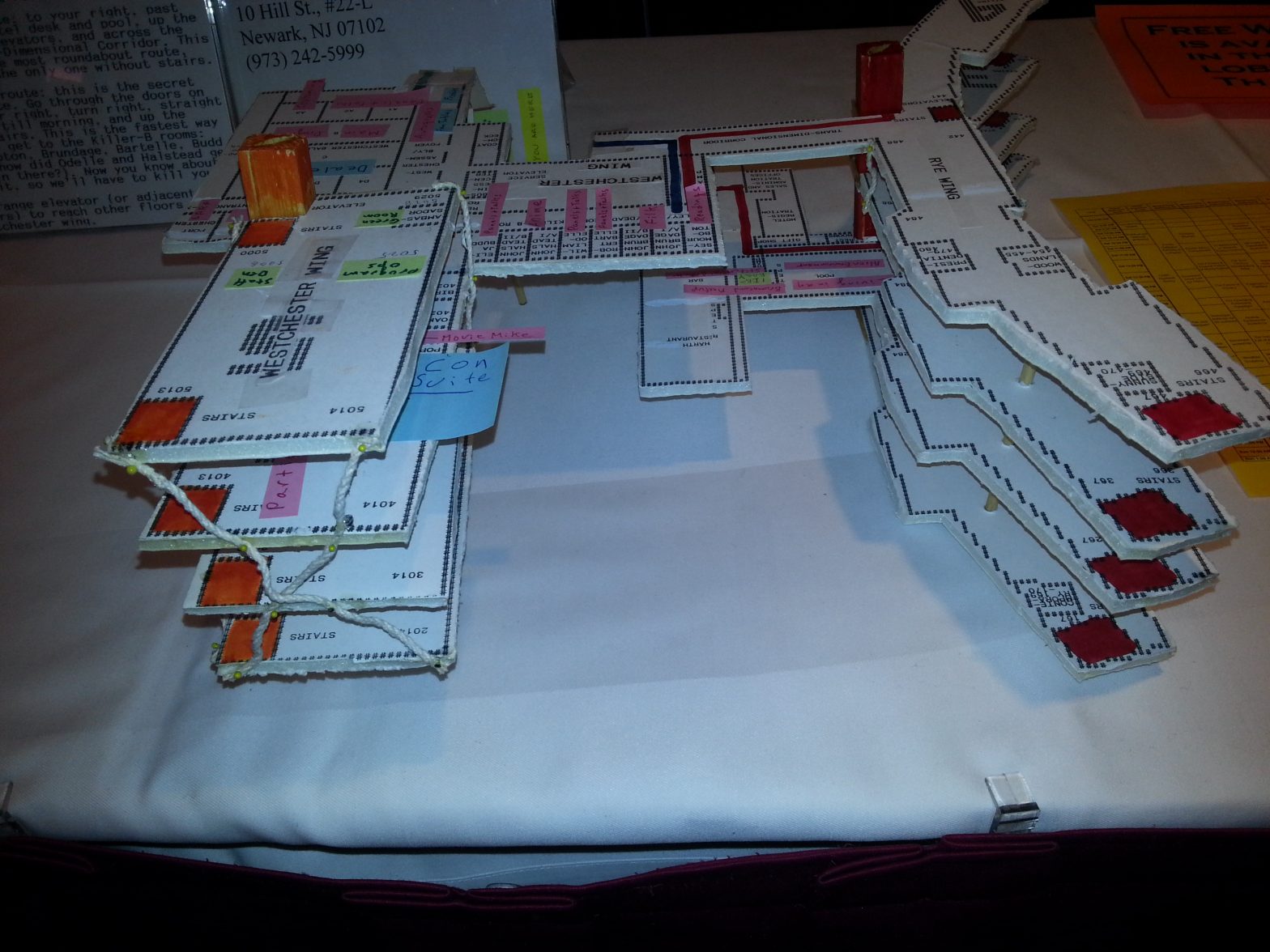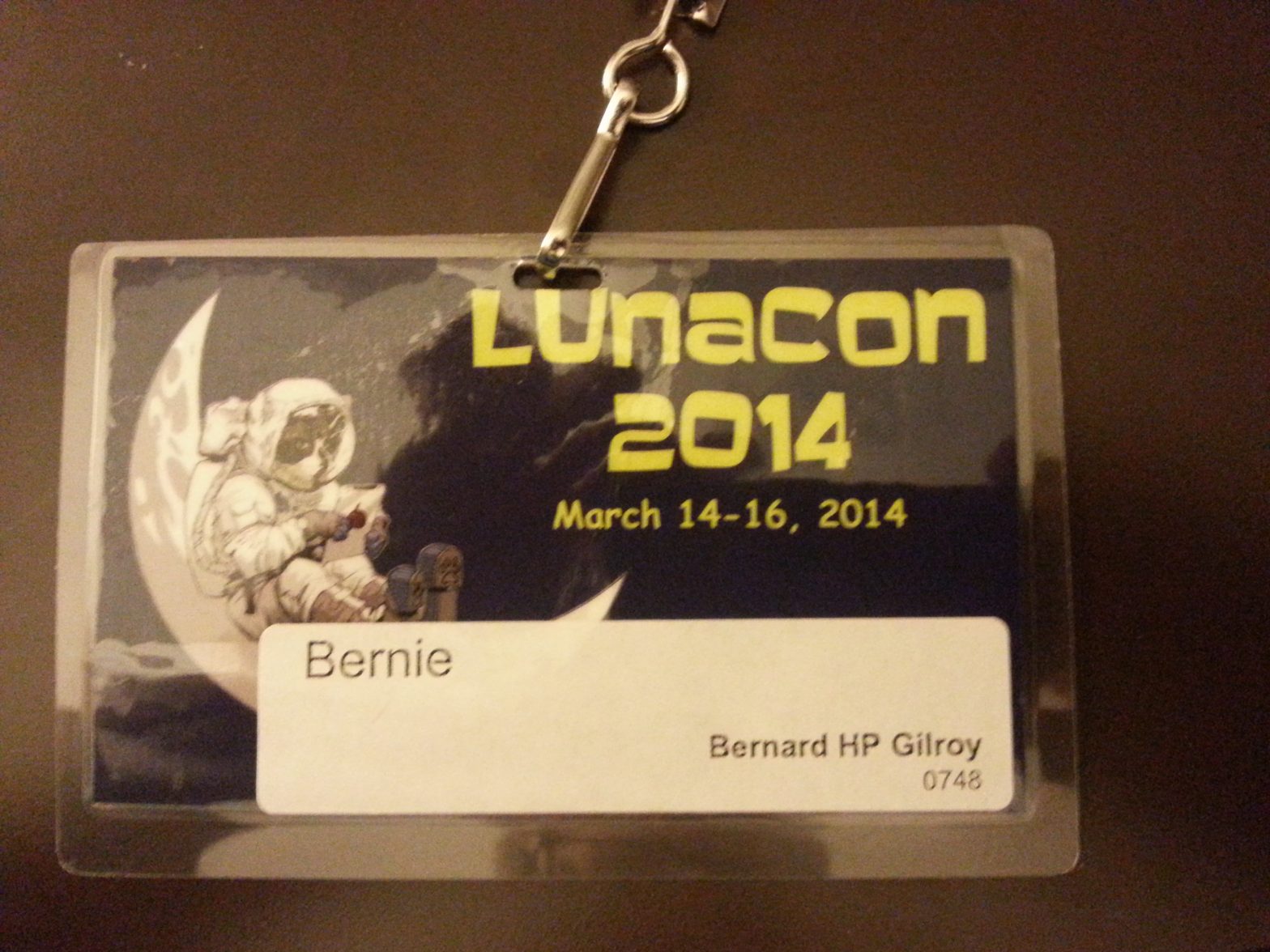
I was excited to attend this game demo. I am a fan of all things Firefly, and actually have a copy of this game but hadn’t had a chance to play it yet. So when a game got underway in the gaming room, I dropped by to check it out.
Author: mongreldogs
-

Lunacon 2014 (1): Friday
OK, so it’s really Saturday when I’m writing this. But it’s about Friday. 🙂
I attended three panels (and one fire alarm): “Building Character“, “Alternate Technologies in Historical Fiction“, and “Firefly: The Game“. I also poked around the dealer’s room for a bit,
-

Lunacon 2014 (1b): Alternate Technologies in Historical Fiction
Panelists: Russ Handelman, James Cambias, Paul Calhoun
And here he is, That Annoying Guy From One Seat Over. This archetype shows up at every con, like a restless spirit.
One of the panelists pointed out that, more or less by definition, this would actually have to be about alternate historical fiction.
Examples of a missed technology:
- Handelman: Could steam locomotives have happened 50 years earlier?
- Cambias: Once you have cloth and fire, you can have balloons. Why did they wait until the 18th century? (Some people think the Mesoamericans had them.)
- Calhoun: complex calculators like the Antikythera Device.
All in all, Calhoun was far and away the least effective panel member.
Technology needs a use before it will be adopted. Muscle power is effective and cheap — you only get machines when the application is impossible or expensive to do with muscle.
Technology that disrupts existing power structures will be resisted by the people in charge of those structures. Until the modern age, societies were not tolerant of that disruption, so change came very slowly. If you want an industrial revolution in ancient times, you’re going to have change the form of antiquity.
Handelman mentioned a book called The Most Powerful Idea in the World, which posits that the Industrial Revolution occurred in England because the English had invented patent law. I wonder if the century of civil war and ongoing disruption was also vital.
Then, there was a fire alarm and we had to flee the building. That cut the session short.
-

Lunacon 2014 (1a): Building Character
Panelists: Mike Flynn and Ken Atlabef.
I was a little disappointed to see that the first panel sported Mike Flynn as a guest. At the last Lunacon, Mike Flynn was the moderator for the panels I consistently liked least. My recollection was that he was a know-it-all who made points only to emphasize his intelligence or to plug his own books, and that the expertise he claimed did not jive with my own knowledge in those areas I had actual expertise in. To be fair, at this panel, he was much more witty and, since it was a writing panel, a lot more effective. He did continue to make it all about him, although it turns out, he can be pretty funny.
The first thing I noticed is how old the audience skewed — I might have been the second or third youngest person there, and I am no spring chicken. This might owe to it being the very first panel to open (before they’ve even set up registration!); maybe only geezers can get away in the mid afternoon on a Friday. 🙂 However, looking over the whole evening, it does seem that Lunacon is trending gray. More on that later.
The title of the panel was a play on words. Rather than moral education, it was about how to craft characters that people will care about and that have the strength to carry your story.
The two panelists did make some really good observations, which I think I’ll find useful when I ever wander back into writing fiction. In no particular order of importance:
- Most sci fi is plot-driven. Other than sci fi, most modern fiction is character-driven. This is probably why sci fi fans complain that other works drag or seem to be about nothing.
- It’s important that characters be true to life. “True” here doesn’t mean factual or literal. True-to-life means that the characters act in ways that make sense to the reader.
- The star of Lord of the Rings is Middle Earth itself. Tolkein didn’t write a story so much as a travelog.
- Altabef felt very strongly that you need to “profile” your characters fully before writing them. He came back to this several times.
- They need to have a back story and you need to know it.
- You must create as much detail as you can.
- But you should reveal only the “telling details” — the ones needed to move the plot or to define the character.
- It’s OK to surprise the reader later but you should never be surprised.
- That’s what a first draft is for — to uncover the ways your characters will surprise you.
- Flynn felt that, when you introduce a character, you should provide the reader with a physical image as soon as possible with as much definition as possible.
- Don’t write stories about ghosts (unless it is a literal ghost story and your character is a literal ghost).
- The character should be doing something that reveals who he is. Think Indiana Jones, who is being Indiana Jones — whip cracking, cautious, observant — within 30 seconds of appearing.
- Dialog is the way you reveal and explore your characters.
- Every character should sound like a person. They should not sound like the same person. 🙂 A note for Aaron Sorkin, I suppose.
- You can flesh out dialog (and break its monotony) with eye movement, facial expression, tone of voice.
- A good writer is observing people all the time and noting their distinguishing tics, mannerisms, etc. You should constantly observe people to try to figure out their motivations — getting them “correct” is less important than the exercise of coming up with them.
- There’s a writing exercise that occurred to me that I want to try: Come up with a situation or piece of conversation and re-tell it for each character.
- Every character should sound like a person. They should not sound like the same person. 🙂 A note for Aaron Sorkin, I suppose.
- Character flaws are useful hooks.
- It’s best if the character’s flaw has something to do with the actual story. 🙂
- It’s imperative to avoid Mary Sue syndrome.
- One technique: Assign each character their Myers-Briggs score, then put them in a situation where they have to act against it. Use that discomfort.
- Villains
- No man is a villain in his own eyes.
- When possible, include an anti-flaw — a redeeming quality — to avoid the Punch Clock Villain problem. Unless that’s what you’re going for, which is OK in its own right.
- Generally, don’t have the villain do it for the evulz.
- A truly great villain leaves the reader unsettled, because he/she demands sympathy or at least understanding.
Then the group degenerated into discussing Batman. Of course.
-

Lunacon 2014 (0): Arrival
After a five-year hiatus, I am back at Lunacon, at the suggestion of my lovely wife (who says it’s important we tend to our individual needs as well as our married ones, and who — I believe — also might like having the apartment to herself for a weekend. 🙂 )
Standing in line to check in, I met a guy for whom this is his 43rd Lunacon. It’s my fourth. I feel a bit like a poser, but oh well. 🙂
Before heading down to register, I figured I’d check into the room, set up Internet (of course!), and then start these posts. I can’t promise much, but I figure that, if the reason I attend Lunacon as opposed to other cons is its traditional focus on writing, I should also do me some writing. Maybe it will be something more, but blog posting is probably a good way to start.
-
Marc Cohn and guests at the City Winery : 2013 Feb 14
I’ve sort of blown the deadline on my 30 Days of Marc Cohn, but I can at least offer up this playlist. 🙂
- “From the Station”
- “Ghost Train”
- “Perfect Love”
- “The Letter” with Jon Leventhal
- “29 Ways”
- “Listening to Levon” with Dave Mansfield
- “Healing Hands” with Rebecca Pidgeon
- “Witness” with Rebecca Pidgeon
- “Silver Thunderbird”
- “Walking in Memphis”
- “Only Living Boy in New York”
- “Into the Mystic”
- “True Companion”
- “The Things We’ve Handed Down”
- “One Safe Place”
-
Art and Design, Fail
I’ve been doing a little reading on the art of design and the failure of art as design. (For example, see this piece about how objects for human use should be designed for, you know, humans.) That led me to the International Push/Pull Pictogram Design Competition, tasked with designing exactly what it says: a non-verbal universal symbol to indicate which way to move a door to open it. Some of them are awfully inspired and some of them are just awful. But the “winner”, I feel, simply replicates the problem:


Quick: Which of these says “This door opens by pulling”?
I would argue that you can make a case for either one. The person on the right is clearly pulling, so maybe that means “Pull this door”. But the door is bulging outward — which says, to me, that the door is not cooperating — it isn’t opening — and so you shouldn’t pull, you should push. (Likewise, the person on the left is clearly pushing but the door isn’t opening; maybe pushing isn’t the right choice.)
The judges picking the winning logo gave the following explanation (in part):
The push symbol is as if the figure is pushing a car and the pull symbol is a figure pulling as if in a tug of war. For extra clarity and to give the impression of force and movement, the doors being pushed and pulled are bowed-shaped.
But in so doing, they fell prey to the same problem they thought they were solving: The pictogram needs to be explained, so it is neither universal nor obvious.
Personally, my choice would have been the one to the right of the upper-left corner of the submissions:

This is unambiguous as to how the door moves. It also serves as a nice warning that the door opens outward, in the second case. (There was a similar one with hands but I think that is too specific: The door opens inward whether you pull it or someone pushes on the other side.)
-
Review: The Hunger Games (2012)
I suspect I’m about to draw down the wrath of the Internet on me, but I finally saw The Hunger Games (the first one) and I’m simply not impressed.
Spoilers and such.
-
Review: The Day of the Doctor
So Doctor Who has been bopping around time, space, and the BBC for 50 years now, and the Beeb put on a very special 50th anniversary episode. My thoughts below. And, to quote a certain archeologist: SPOILERS
-

Miracles and Wonder
I just received the Kingston 64 GB USB flash drive shown above. It holds (duh) 64 gigabytes of data. I’ve included a US quarter for size comparisons. My first computer was a Commodore-64, for which I had the venerable C1541 floppy disk drive. That used 5.25″ floppy disks — which were actually floppy, you could bend them (though that was not advised!) — and could cram as much as 165 kB onto each one. Yes, that’s kilobytes. This means that, to hold the same amount as the flash drive, I would need something like 406,721 floppy disks. Laid end-to-end, they would stretch about 33 miles, or half again as long as you’d need to bridge the English Channel. Laid out in a square, they would cover an area of about 1.8 acres or 1.44 (American) football fields. Stacked, they would stand 650 m tall, or about 1.46 Empire State Buildings. A single floppy disk cost about $2.25 (when purchased in bulk, and we would obviously have to do that!). So the cost to own this much storage would be about $915,120. We probably shouldn’t neglect you’d have to buy the drive as well — that would add $400. OK, we probably could neglect that. Oh, wait. That was in 1982. According to the Inflation Calculator, $915,520 in 1982 would be equivalent, more or less, to $2,144,035 in 2012. (Information not available for this year yet.) I paid amazon.com the princely sum of $37. And got free shipping. (And don’t need a warehouse to store my 400,000 disks!) My point? We live in an age that would leave Scheherazade a-gasp and disbelieving. We live in an age of miracles.Also, get off my lawn.