Category: books

  • BLG’s Top Reads of 2022

    Here’s a look back at the best I read during 2022.  These are roughly listed best, first; but the quality was generally so high as to make fine distinctions specious.  Some comments on each follows the lists.  I’ll be fleshing those out over the next few days so visit to see updates, if you like.

    Also, I have to give a shout-out to my wonderful wife, who bought me most of these books last Christmas and keep me happily swamped in reading material for most of the year.

    Fiction

    Non-fiction

    • How to Hide an Empire: A History of the Greater United States by Daniel Immerwahr
    • Destiny Disrupted: A History of the World Through Islamic Eyes by Mir Tamim Ansary
    • Money: The True Story of a Made-up Thing by Jacob Goldstein
    • Shady Characters: The Secret Life of Punctuation, Symbols, and Other Typographical Marks by Keith Houston 
    • The Wordhord: Daily Life in Old English by Hana Videen
    • Immune: A Journey into the Mysterious System That Keeps You Alive by Philipp Dettmer
    • Hitler’s American Gamble: Pearl Harbor and Germany’s March to Global War by Brendan Simms and Charlie Laderman
    • Papyrus: The Invention of Books in the Ancient World by Irene Vallejo
    • Who Killed Jane Stanford?: A Gilded Age Tale of Murder, Deceit, Spirits and the Birth of a University by Richard White
    • The Alchemists: Three Central Bankers and a World on Fire by Neil Irwin
    (more…)
  • Books 2020

    Evermore

    Paris at the End of the World

    Godsgrave

    Mythos

    Darksdawn

    Working Futures

    Bridge of Spies

    Redemption Falls

    The Secret Lives of the US Presidents

    This is How You Lose the Time War

    Cities: The First 6000 Years

    World War Z

    Middlegame

    A Brightness Long Ago (re-read)

    The Consuming Fire (re-read)

    The Last Emperox

    Star Wars: Darth Vader Vol 1: Vader (graphic novel)

    The Diamond Age (re-read)

    Murderbot 1: All Systems Read

    Murderbot 2: Artificial Condition

    A Memory Called Empire

    The Invisible Hook

    Target: Vader (graphic novel)

    Renaissance Diplomacy

    Binti

    Sixteen Ways to Defend a Walled City

  • Books 2019

    Books 2019

    A Song for Arbonne by Guy Gavriel Kay

    This was a re-read for me, as it just became available on Kindle.  It in fact wrapped up my complete re-read of Kay’s fiction, which I mostly handled in 2018.


    Grant by Ron Chernow

    After reading the award-winning (and musical-inspiring) Hamilton by Chernow, I was moved to pick this one up — especially after a positive review by the Grant-fanatic in my life.  I’ve only read through the start of his presidency, but Chernow delivers the same unaffected but impactful style and brings his subject to life.  Incidentally, there are a lot of books about the Civil War; they often neglect the western campaigns. This book covers the War, of course but its subject requires Chernow to pay attention to that part.


    The Prophecy Con by Patrick Weekes

    Book 2 of the Rogues Of The Republic, a follow-up to The Palace Job

    The Paladin Caper by Patrick Weekes

    Book 3 of the Rogues of the Republic.

    Taken together, these three books are a decent if low-impact fantasy series. Intentionally or not, they have a real Leverage vibe (especially the third one), although they’re not quite as polished as John Roger’s classic TV show. Con jobs in fantasy settings are becoming more common (The Lies of Loch Lamora, the Mistborn series) but they all seem to veer into straight up combat at some point. Weekes does a decent job moving the plot along and the (huge) team of players is well-constructed, with everyone getting sharply-drawn personalities.


    The Three Body Problem by Cixin Liu

    The Three Musketeers by Alexander Dumas pere

    Solaris Rising Vol. 2 anthology

    Tales of the Dying Earth by Jack Vance

    A People’s Future of the United States anthology

    Ancillary Justice by Anne Leckie

    A Brightness Long Ago by Guy Gavriel Kay

    Raymond Chandler’s Phillip Marlowe ed. by Robert B. Parker

    The Paper Menagerie and Other Stories by Ken Liu

    Thrawn by Timothy Zahn

    The Raven Tower by Anne Leckie

    Exhalation: Stories by Ted Chiang

    John Quincy Adams: Militant Spirit by James Traub

    An excellent biography of the 6th President, whose term in the Oval Office was in fact one of his lesser accomplishments in the fields of diplomacy and public service.

    James Madison

    The Clockwork Dynasty

    Neverwhere

    The Collapsing Empire

    The Consuming Fire

    A Wizard of Earth-Sea

    Fall, or Dodge in Hell

    The Collected Works of Arthur C. Clarke

    The Map of Knowledge

    Nevernight

    Everless

    The Fifth Season

  • The power of the dark side

    [amazon_link asins=’0785192557,0785192565,0785199772,0785199780,0785197893′ template=’ProductCarousel’ store=’gilroy0-20′ marketplace=’US’ link_id=’0a4327d5-eb7a-11e7-a142-c169eec473c4′]

    No, this is not a political post.  🙂

    I absolutely tore through the omnibus Kindle editions of the Darth Vader comic (one of several in the rebooted Marvel line).  I guess it really paid off for Amazon to make Volume 1 free to Prime members because it hooked me fast.  I ended up buying Volumes 2 through 4 as well as the crossover event Vader Down.  Combined, they cost me about what a standard novel would, and they were well worth the money.

    Oh, spoilers below.

    (more…)

  • What is a library?

    What is a library?

    I am far from the first to ask this question in an increasingly-electronic age, and I am sure that my answer will be far from unique.  But my wife and I have batted the question around a couple of times and I wanted to get my thoughts down.  The proximate cause of our discussion was an meditation on the large space allocated to the library in the school where I teach, the dusty and ill-utilized books moldering there, and the concern that the library might come to be seen as “wasted” space.  The thought of a college-prep school without a library seems equal parts worrisome and absurd, yet it’s hard to argue in favor of the proposition that the stacks continue to serve their traditional vital role in education.  Can the library be saved when books have fallen out of favor?

    (more…)

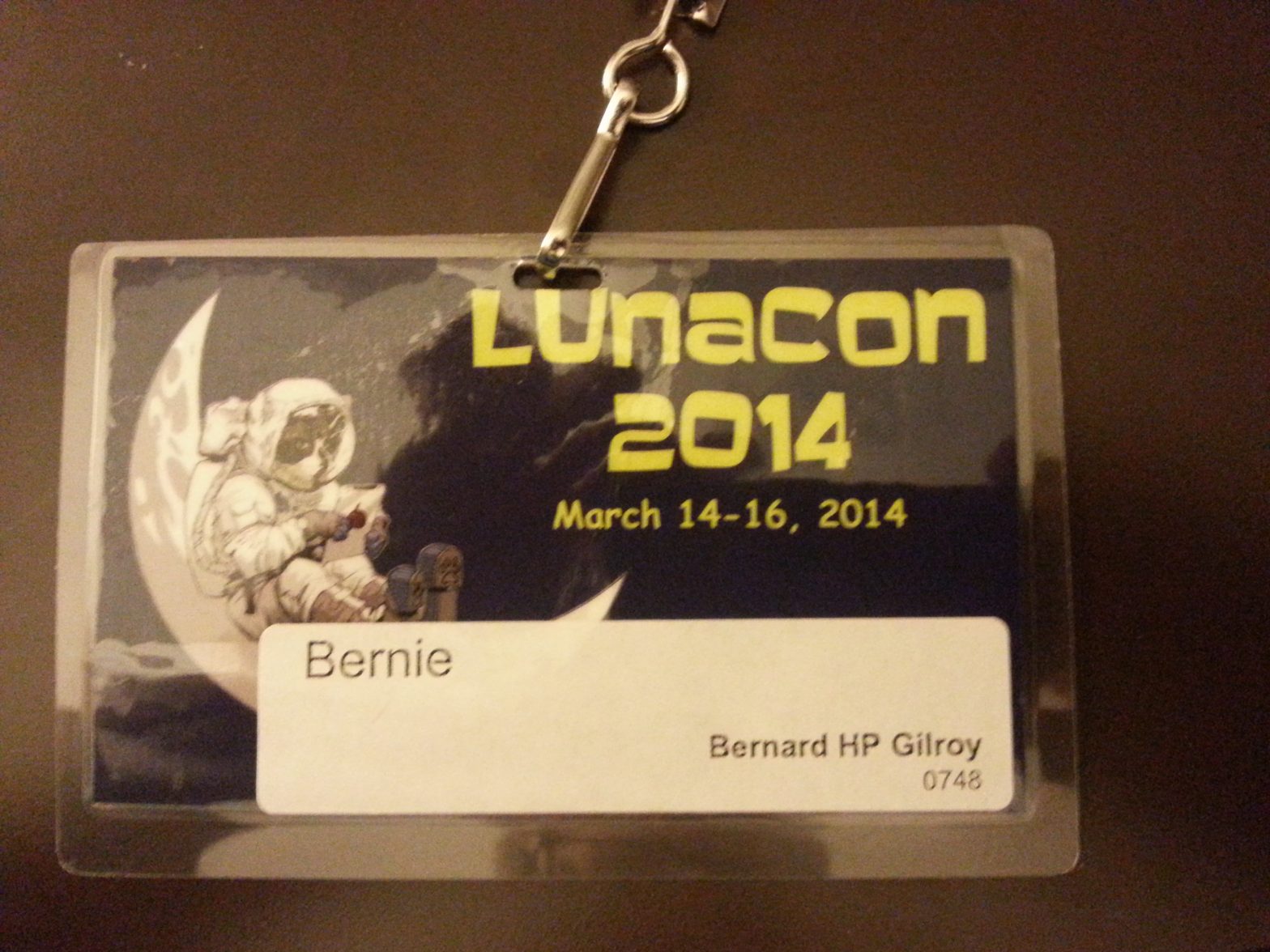
  • Lunacon 2014 (1b): Alternate Technologies in Historical Fiction

    Lunacon 2014 (1b): Alternate Technologies in Historical Fiction

    Panelists: Russ Handelman, James Cambias, Paul Calhoun

    And here he is, That Annoying Guy From One Seat Over.  This archetype shows up at every con, like a restless spirit.

    One of the panelists pointed out that, more or less by definition, this would actually have to be about alternate historical fiction.

    Examples of a missed technology:

    • Handelman: Could steam locomotives have happened 50 years earlier?
    • Cambias: Once you have cloth and fire, you can have balloons.  Why did they wait until the 18th century?  (Some people think the Mesoamericans had them.)
    • Calhoun: complex calculators like the Antikythera Device.

    All in all, Calhoun was far and away the least effective panel member.

    Technology needs a use before it will be adopted.  Muscle power is effective and cheap — you only get machines when the application is impossible or expensive to do with muscle.

    Technology that disrupts existing power structures will be resisted by the people in charge of those structures.  Until the modern age, societies were not tolerant of that disruption, so change came very slowly.  If you want an industrial revolution in ancient times, you’re going to have change the form of antiquity.

    Handelman mentioned a book called The Most Powerful Idea in the World, which posits that the Industrial Revolution occurred in England because the English had invented patent law.  I wonder if the century of civil war and ongoing disruption was also vital.

    Then, there was a fire alarm and we had to flee the building.  That cut the session short.

  • Review: Perdido Street Station

    Rating: 3 out of 5

    I picked up Perdido Street Station because I was looking for a good steampunk novel, especially after Dreadnought, and the reviews were strong. This book was supposed to be amazing, sweeping, and alluring – a detaile new world to explore. After finishing it, I felt the praise was overblown. The world is complex and involved, but the steampunk setting was wildly inconsistent. Though the book starts as hardcore steampunk, it eventually decomposes into low fantasy – all the trappings of industrial magic but no clear concept of what that would mean. Though much of the setting is explicit in using steam, there are “aetheric flows” and, for some reason, literally miles of insulated cabling in a society that seems to have very little electricity. There are zepplins, of course, and steam-driven automatons. But it all seems, well, lazy.

    The story is OK but hardly epic. Its initiation and its resolution both depend on astonishing coincidence, of the sort that sinks high school writing. The characters have moments of depth and substance but never really take off. Character threads start and trail off to no resolution. The first part of the book is quite slow. The middle third is well-done and sets up situations and themes that offer much promise. Once the actual action starts, though, it all goes out the window and the plot lurches to its frenetic end a complete mess.

    My overriding impressions is that China Meiville bit off way more than he coukd chew, and left us with the partly-masticated glop that was left over.

  • Currently Reading: Second Quarter 2011

    • Better to Beg Forgiveness by Michael Z. Williamson
    • Perdido Street Station by China Melville

    ?????

  • Currently Reading: First Quater 2011

    • American Scripture by Pauline Maier
    • Consider Phlebas by Ian Banks
    • Assassination Vacation by Sarah Vowel
  • My summer reading

    Just to put it in one place, here’s what I’ve read and what I hope to read this summer.

    Already Read

    • Neverwhere by Niel Gaiman
    • The Engineer Trilogy by K. J. Parker
      • Devices and Desires
      • Evil for Evil
      • The Escapement
    • To Engineer is Human by Henry Petroski (2010 0708)
    • Under Heaven by Guy Gavriel Kay (2010 0715)
    • Ghosts of Manhattan (2010 0720)
    • Metatropolis edited by John Scalzi (2010 0722)
    • Stardust by Neil Gaiman (2010 0724)
    • The City’s End: Two Centuries of Fantasies, Fears, and Premonitions of New York’s Destruction by Max Page (2010 0726)
    • Tron by Brian Daley (2010 0731)
    • 1453 by Roger Crowley
    • The Unincorporated Man by Dani Kollin & Eytan Kollin
    • Fragile Things by Neil Gaiman
    • The State of Jones: The Small Southern County that Seceded from the Confederacy by Sally Jenkins & John Stauffer
    • The Affinity Bridge by George Mann

    On the agenda

    • The Global Achievement Gap by Tony Wagner
    • The Book in the Renaissance by Andrew Pettegree