Category: Health of the Republic

  • Happy Victory over the Confederacy Day

    Happy Victory over the Confederacy Day

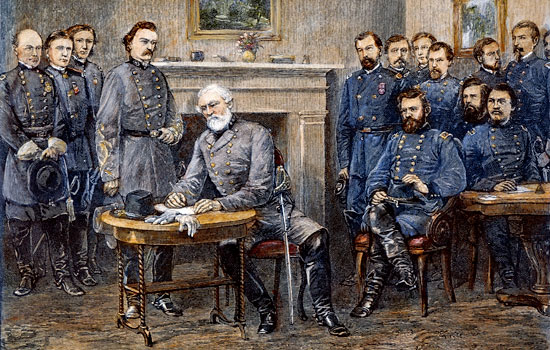
    Lee Surrenders

    On this day one hundred fifty years ago, a scruffy, scrappy, but determined general accepted the surrender of his well-born, well-dressed, and traitorous counterpart, effectively ending a vast sedition launched in the name of slavery, orchestrated by cowardly politicians, and fought — like most wars are — by poor men dying at the behest of rich men. There was no nobility in the losing side; there was no honor; there was only the proposition that one man might justly hold another as property, and that in support of that one twisted principle, oaths may be broken, loyalty suborned, and a great democracy threatened with sectarian dissolution.

    Stragglers of the Confederate army fought on for a few more weeks. Their descendants, stragglers of history, fight on today. Their cause is equally dishonorable, equally seditious, and, thankfully, equally ultimately futile.


  • Pat Buchanan is an idiot

    Sorry for being so obvious.  But I’ve read his latest ill-informed anti-immigrant screed and couldn’t stay quiet.

    Buchanan’s thesis is that we were once a unified country but now since 1960, we’ve been in decline.  First off, it’s a little suspicious that the magic time was exactly when Pat Buchanan (born in 1938) had just reached majority age.  Nearly everyone looks back on their twenties as the halcyon days.  It’s the moment you first achieve independence from your parents, when you come into your own agency, and when you (most likely) start paying attention to the world around you as if you were a part of you.  That is, how the world is becomes your frame of reference for how the world should be.  But really that’s just the drug of nostalgia, and it’s no different than Homer Simpson declaring that “rock attained perfection in 1974 — it’s a scientific fact”

    .

    Buchanan then pivots to alerting us to the existential threat to America poised by unaccompanied children fleeing violence.  He of course invokes sainted Ronald Reagan of blessed memory: “For, as Ronald Reagan said, a nation that cannot control its borders isn’t really a nation anymore.”  I’m not exactly sure how he squares that with the open borders of the Roman Empire, or the British one, or indeed, most of US history.  But whatever.

    Buchanan also invokes the Federalist papers and John Jay’s comment that “Providence has been pleased to give this one connected country to one united people – a people descended from the same ancestors, speaking the same language, professing the same religion, attached to the same principles of government, very similar in their manners and customs. … ”  This might have made good propaganda, but I’m fairly sure that Jay’s words would have irked the already-numerous German, Scottish, Irish, Danish immigrants who had fought in the Revolutionary War to help establish this nation.

    Buchanan asserts “We were not a nation of immigrants in 1789″, which is just laughable.  Heck, Andrew Hamilton — another of the authors of the Federalist Papers — was an immigrant to these shores.  While many of the colonists were born in America, many had travelled here.  And above all of that, you might want to ask a Native American, who might remind you that all the White guys were immigrants or recent descendants of immigrants.

    Buchanan also says “The republic of the founders for whom Jay spoke did not give a fig for diversity. They cherished our unity, commonality and sameness of ancestry, culture, faith and traditions.”  This certainly makes one wonder about the long, drawn-out, sometimes-vicious fights in the Continental Congress between (usually) the New England and the Deep South contingents.   Oh, also all that time and effort spent trying to square the circle on the South’s “peculiar institution”.

    This brings up the largest hole in Buchanan’s argument.  We used to be all one happy, unified, uniform family?  What drugs is he on?  Look at the treatment of any minority population in the US (and, hey, we do actually have some and always had): the Native Americans, the Blacks, the Chinese.  Heck, look at how the Irish were treated.  It’s a little hard to swallow that we were a unified culture.  Instead, we had the in-power culture (more or less the WASPs), who then simply declared that other cultures were backward, uncivilized, and plain old irrelevant.  Buchanan’s reasoning boils down to “There was only one culture — as long as you ignore all the other ones.”

    It is nice that Buchanan admits, obliquely, that maybe not everything was rainbows and unicorns:  “And though the civil rights movement had just begun, nowhere did black peoples enjoy the freedom and prosperity of African-Americans.”  That’s right, in the magic year of 1960, White culture finally started to grudgingly offer some semblance of fairness to the Black population, a mere century after the bloodiest war in American history and the abolition of outright slavery.

    Quibbling with Attorney General Eric Holder’s assertion that America is “a fundamentally better place than we were 50 years ago,” Buchanan laments that nonetheless “We are no longer one unique people ‘descended from the same ancestors, speaking the same language, professing the same religion’.”  But the fact of the matter is, we never were.  You can only pretend that we were by ignoring the reality, twisting the history, and unlearning the lessons.  You can only pretend we were when you define “real America” as “exactly and only the small patch of ground I grew up on”.

    As evidence of how far we’ve fallen, Buchanan lists a bunch of things:

    We are from every continent and country. Nearly 4 in 10 Americans trace their ancestry to Asia, Africa and Latin America. We are a multiracial, multilingual, multicultural society in a world where countless countries are being torn apart over race, religion and roots.

    We no longer speak the same language, worship the same God, honor the same heroes or share the same holidays.

    But he says these like they’re bad things, whereas I think they speak to the enduring strength of this nation, to adapt, persevere, and improve itself — to strive always to become a “more perfect Union”.  For someone who sings of “American exceptionalism”, Buchanan misses what makes us exceptional:  Not the fortuitous vast natural resources, or the particular spot of earth on which we stand, or the world’s oldest free trade zone or the world’s oldest constitutional republic, not a fictitious single language or single culture.  We are a nation of peoples, a weird and wonderful dream bringing together cultures, and languages, and experiences, and hopes and aspirations from all that humanity has to offer.  America the nation is an idea, not a place or a people.  And that is largely unprecedented and ambitious.


    A final comment:  One of the things that so disturbs Buchanan is that “Stonewall Jackson and Robert E. Lee are out of the pantheon”.  And I say, Yea! to this, and good riddance.  The triumph of the American spirit is that we can finally reject these traitorous and seditious, fundamentally dishonorable men who abandoned the United States and its Constitution, not to mention their own sworn oaths, in a parochial construction of duty to defend a heinous state founded on the noxious principle that some humans have, as a divine right, the right and even obligation to own other human beings.  (If you’re one of the revisionists who want to argue that “the Civil War wasn’t about slavery”, I suggest you read the ordinances of secession, or indeed, the Constitution of the Confederate States.   See also an analysis of slavery in the Confederate constitution, or a similar analysis.)

  • Happy Tax Day!

    And I mean that non-ironically.  I don’t like paying taxes, but I am proud to do it.  Taxes are not only necessary to maintain the way of life we value.  They are a direct investment in the very concept of civilization.   Taxes are the explicit statement that we are a community and we have a communal responsibility to each other.  They are also the explicit recognition that no one is in this alone, that no one is solely responsible for his or her own success, and that we are, to some measure, dependent on each other.

    Yes, I inveigle against waste and fraud, just like everyone else.  Perhaps even more so, because they are a violation of this trust, that the communal burden be fairly borne and communally valuable — that no individual benefit unduly.  But the current fetish on minimizing taxes (even at the cost of undermining society) boggles my mind.  It reeks of hubris and solipsism.

    Taxes are a burden but  not all burdens are bad.  Jingoists like to lecture us “Freedom isn’t free” — and indeed, it isn’t.  Part of the cost — not the lion’s share, but not a negligible one — is directly an economic one: The taxes we pay.  You cannot defend a nation, or provide speedy justice, or protect the innocent, for free.  You cannot offer hope and opportunity, or discover new cures, or build a better future, for free.  The American project, whatever that turns out to be, is bigger than any one person or any one group.  Taxes are part of the sinew that binds us into one nation.

    Taxes help make clear: We are all in this together.

    So again, I say, Happy Tax Day!

    (For your amusement, here’s a link to the original income tax forms.)

  • The defining feature of modern Republicanism

    It’s not small-government. It’s not anti-tax screeds or culture war crusades. It’s not being pro-big business or pro-gun. It’s not being anti-choice or anti-gay. It’s not suport of “traditional marriages” or of non-traditional “special interrogation”. It’s not being pro-Gitmo or anti-drone or pro-Keystone or anti-FEMA. It’s not even being sexist or being racist.

    It’s a complete and utter lack of empathy, and an unhealthy disdain for the same in others.

    How else do you explain the sudden 180? shifts in philosophy once the consequence of the party line hits home? Dick Cheney supports gay rights, because his daughter is a lesbian. Bob Portman now supports same-sex marriage, because his son has come out of the closet. Mark Kirk suddenly understands the value of government health care, once he has a brush with death. It’s how Republican governors can decry federal spending on disaster relief… right up until their state needs it.

    Republicans like to claim that they’re the party of grown-ups, reining in those rascally irresponsible Democrats. But a hallmark of maturity is the development of empathy — the ability to think beyond the confines of your personal experiences and to imagine, however imperfectly, the life lived by people who are not you. On that measure, the Republican Party is a haven for toddlers and crybabies. I applaud Senator Portman for revisiting his philosophy in light of new evidence, but if we have to wait for a singular personal experience for each and every Republican, it’s going to be a long long slog.

  • De-tuned

    I wrote this nearly five years ago.  I was mad then; now I’m more or less just resigned.  The intellectual commons is being fenced off, now more than ever.  I think we’re losing more than outlets for creativity or profit; we’re losing the shared language to remember who we were, who we are.

    ==============

    De-Tuned

    Recently I’ve come to feel under assault.  Not in my person but in my past.

    One of the guilty pleasures of my childhood was a TV show called The Greatest American Hero, which I adored when I was twelve.  For those not fully up on their Reagan-era television trivia, the show involved an ordinary guy — a school teacher, in fact — who was given a “supersuit” by friendly aliens in a Close Encounters-type flying saucer.  The suit, a ridiculous set of red long underwear, empowered Ralph the teacher with powers reminiscent of Superman: flying, strength, immunity to bullets.  But unlike cool and collected Clark Kent, Ralph Hinckley has all the usual foibles of humanity: he can be frightened, angered, made jealous.  Moreover, he loses the instruction book and has to figure out the suit on his own.

    In my memory there has always stuck out one particular episode, called “Operation: Spoilsport“.  (I have since learned the title; at the time, I was not the type who appreciated the importance of titles to works.)  It marks the return of the “little green guys“, who warn Ralph and his FBI partner Bill about the impending destruction of the Earth.  Probably to make the aliens seem mysterious and transcendent, the writers decided that they could speak to Ralph only by adjusting the car radio so as to catch little snippets of regular broadcasts that, put together, made up the message.  Even at the time this struck me as a clever trick to make the aliens sound, well, alien.

    Here’s where the assault comes in.  To bring home their point — to underscore the stakes — the aliens keep sending Ralph the same song over and over.  From 1982 until recently, I had thought that the song was “Eve of Destruction“, a song by P.F. Sloan that Barry McGuire took to a place on the Billboard charts in 1965.  I was 12.  I hadn’t ever paid attention to 1960s music.  The Viet Nam War was, at best, the source for action movies like First Blood.  I knew about Red China but I almost certainly didn’t know why Sloan would compare it to Selma, Alabama.  In short, the song should have been, to me, a jumble of confused rage directed at outdated cultural references that had no meaning for me.

    I was only 12.  But it was 1982, two years into the Reagan presidency.  Six months earlier the President had nakedly called the Soviet Union an “evil empire” and made undiluted opposition the cornerstone of his foreign policy.  The New York Daily News had published its periodic map of the city, showing the hypothetical effect of the latest Soviet warhead if it were to be detonated above the Empire State Building — cryptic squiggles and broadly-drawn circles whose radii indicated just how far away you had to be to escape each of the various killing zones: the immediate blast region and the flash-immolation zone and the merely concussive damage area.  Everyone simply knew that World War III was on its way, that it would start with a Soviet invasion of West Germany, and that it would end with, well, The End, capital “T”, capital “E”.

    Small wonder, then, that I found myself morbidly drawn to this song with its rough-hewn, unworkable, unrelenting refrain: “Tell me, over and over and over again, my friend, how you don’t believe we’re on the eve of destruction”.  Small wonder, perhaps, that I found comfort in the thought that maybe, out there somewhere, was an ordinary high school teacher in a ridiculous suit of red long underwear who could step in and save the world.

    Time passed.  The Soviets never came over the North Pole, or from Cuba, or even from East Germany.  Reagan went to Reykjavik and then to Berlin (“Mr. Gorbachev, tear down this wall!“).  I went to high school and then to college and then to grad school.  The Greatest American Hero went to reruns and then to syndication hell and then to oblivion.  Everybody forgot that at one time everybody had known that World War III was imminent.  There was peace, for a time, and there was prosperity, for a time, and there was security … for a time.

    Then they were gone, and everyone — whether they knew it or not — was humming the refrain from Barry McGuire.  I found myself doing it consciously from time to time.  I took some obscure hope in remembering how eerily prophetic it had seemed in 1982 and in how its prophecy had utterly failed to come to pass.  From my more nuanced vantage I knew now that McGuire was singing more of the raging undercurrents of hate and mistrust that spawned the violence of the Sixties, and I even recognized that that river still ran strong and deep in human affairs.  But it was a piece of my youth, one of those signposts along the way toward maturity.  “Eve of Destruction” had been, through the medium of The Greatest American Hero, part of the soundtrack of my growth from the simplicity of childhood toward the complexity and shades of adulthood.

    Or so I had thought, for two decades and more.


    Eventually, Anchor Bay Entertainment released, after many delays, the DVD set of the second season of The Greatest American Hero.  Episode #2 was “Operation: Spoilsport”.  I opened the box and jumped to that episode immediately.  I reveled in the guilty pleasure of being a twelve-year-old proto-geek again.  It was everything I remembered — until the end of the second act.  The little green guys returned, they futzed with Ralph’s radio, and out came… some random manufactured pop hit.  Where was Barry McGuire’s gravelly rage?  I rationalized that I had misremembered.  After all, there were several instances in this episode when they sent Ralph a song.  Probably the writers had built up to “Eve of Destruction” and then I, struck by its power, had expanded it to fill the episode in retrospect.

    Three more acts came and went.  Three more quasi-pop songs too upbeat for their faux angst.  No Barry McGuire.  No “Eve of Destruction”.  It was the final act and there was only one more opportunity for the green guys, and now it wouldn’t even make sense — the crisis was past.  Suddenly, the end credits rolled.  I wondered if I was crazy.  Before playing the disc, I would have sworn in a court of law on a stack of Bibles that the key song from “Operation: Spoilsport” was “Eve of Destruction”.  Had I gotten my wires crossed?  Perhaps somewhere in the past twenty years I had come across “Eve of Destruction” and subconsciously recognized its appropriateness, then pasted it retroactively into my memory of “Operation: Spoilsport”.  If the human mind was so malleable, if I could unknowingly alter my memories so thoroughly — well, the world was suddenly a much scarier place, and not just because of Soviet nukes.

    Before checking myself into a mental hospital, I did a little bit of research.  Only a few minutes online brought me some confirmation of my sanity.  If I had invented the insertion of “Eve of Destruction”, at least I was not alone in my delusion, because several different message boards were aflame with people indignant over its removal.  The true story was simple and, a propos for the times, more base:  money.

    The Greatest American Hero, it turns out, was ahead of its time a little in that it incorporated “regular” music deeply into the storylines — a tactic used to more lasting impact on Miami Vice a few years later.  Because it was a pioneer, the show’s creators never thought to secure reproduction rights for home collections.  In 1982, nobody could buy an entire season of a TV show and certainly nobody thought anybody would if offered the chance.  Everybody “knew” that when a series ended, its appeal vanished and its money-making chances went as well.  Just like everybody “knew” that World War III was just around the corner.  Today of course the home market represents the lion’s share of revenue for a project and no one would forget to purchase those rights.

    Anchor Bay faced two options:  Pay for all the songs again and raise the price (and cut their profit margin).  Or splice in generic songs to which they had the rights, and hope nobody would notice.  Judging from the vitriol flowing online, they made the wrong call.  And I have to admit, I share the anger.  Quite some time has past since I discovered the substitution, and it still rankles me.  I’ve been trying to figure out why.  After all, it’s just a TV show and — I have to admit — not really the best one, either.  It’s campy and goofy; the situations ludicrous and the characters cardboard.  While I’ve always had a soft spot for The Greatest American Hero, I’ve never considered it my favorite show nor even among the best.  Why would it inspire a slow-burning anger at its modification?

    But of course it’s not the modification of the show that inspires the anger.  It’s the mutilation of my memory.  Precisely because the writers had woven the music into their story, it couldn’t be simply spliced out.  A purpose of art is to evoke change and response, and clearly, that episode had attained that purpose, at least for me.  “Eve of Destruction”, learned by me in that particular context, had played a part in the formation of the adult me, of who I became, of who I am.  Now it had been callously and carelessly removed, edited out in a creepily Soviet fashion.  My memories, my past, were not out of bounds, it would seem.

    The whole affair has given me a better insight into a different work of literature.  Without any intention by Anchor Bay, they gave me just a taste of Winston’s life in 1984.  Big Brother wasn’t out to rule the world, here, but Big Brother Incorporated didn’t mind trashing the past to make a quick buck.  What’s more, there seems to be a growing use of and a growing acceptance of this sort of media revisionism.  We are losing any idea of a shared cultural base.  The cultural commons are being carved up and fenced in.  But a person’s identity is myriad and shared, and cutting up the commons means carving up ourselves.  Soon we could just be atomistic stubs bouncing off the walls we erect between us.

    Think on that and then tell me again, my friend, if you don’t believe we’re on the eve of destruction.
  • Newshound explains: The Curious Case of the Silent Filibuster

    http://newsbound.com/the-silent-filibuster/

    This is a really good, really clear, and (mostly) nonpartisan explanation of the rise of the silent filibuster in the US Senate — where it came from, the damage it does, how it might be fixed.

  • Noah Smith on the Rise of the Machines

    Here’s a worthwhile read from Noah Smith on the future of an economy where most work is done by robots.

    I’ve actually thought about this for a long while.  How can a democracy survive if all the economic oomph lies in the very few owners of capital?  As much as he was (justifiably) derided, President George W. Bush did have a good turn of phrase: How do we ensure we are an “ownership society” and not an owned one?  How do we make sure that wealth doesn’t freeze out to those lucky enough to be born to parents lucky enough (or ruthless enough) to have amassed a disproportionate share of the resources?

    Maybe long term, everyone else stops reproducing and dies out.  (But it’s hard to imagine that without draconian enforcement.)  Maybe everyone else gets fed up and smashes the system, or the people on top heartlessly crush them.  (That seems to be the common sci fi prediction.)  It’s hard to see how we get from where we are to something like Star Trek’s Federation, where everyone is meaningfully employed and wants for nothing.

    I agree with Noah but more emphatically: This is a problem we need to solve, and fast. It’s a bit dismaying to see all the sturm-and-drang arguing over how the classical economy works, when it seems pretty clear the terms are all about to change abruptly and massively.  It’s yet another reason why I confidently predict this will be the Final Century of human history:  Either we figure it out and become something new, or we’ll destroy ourselves in the paroxysms of the doomed struggle to keep things the same.

  • Sure, but just imagine how sorry you’ll be if the British invade…

    Kellermann found people turned those guns on themselves and others in the house far more often than on intruders. “In other words, a gun kept in the home was 43 times more likely to be involved in the death of a member of the household than to be used in self-defense,” he says.

    (Source: NPR)

  • Raw Deal

    TR had the Square Deal.  FDR had the New Deal.  Harry S has the Fair Deal. Barack Obama will have the Raw Deal.

    So a debt-ceiling “deal” has been reached.  Going in to this, the President was willing to compromise but had a few lines in the sand:

    1. Some deficit reduction would have to come from new revenues.
    2. There would be an extension through the 2012 elections.
    3. The big social safety net programs would be protected.

    What did he get?  None of these.  None of them.  What he got was a temporary extension of the debt ceiling, but he must take ownership of it now and again in six months.  He got a “super congress” stacked against him with triggers that hurt only one side.  He got an agreement that the hostage-taker would not shoot the hostage at this time, though he let the hostage-taker keep the gun and even gave him more bullets.

    He got rolled.  That’s what he got.

    I am not a Tea Party default denialist.  I fully understand that the scope of a default would be unprecedented and uncharted and very likely catastrophic.  I just don’t see how surrendering the principle of democratic government is better.  The Republicans know that their policies would be unpopular — fatally so, in fact.  So they don’t try to enact them.  Instead they manipulate the far-too-easily-manipulated Democrats into making the hard choices, doing the hard things, and then getting savaged by an electorate that doesn’t understand what’s going on and can’t be bothered to learn.

    There are many who say the President should have stared down the Republicans and bluffed harder about using the so-called constitutional option, invoking the 14th Amendment.  I’m not one of those; I don’t believe in bluffing.  He should have stared down the Republicans fully intending to invoke the 14th Amendment if need be.  He should have said, This far and no further.  He would have looked decisive because he would have been decisive.  He would have the public on his side.  More importantly, he would have been right.  And given the certainty of disaster implicit in the rise of the Crazy Caucus to power, a roll of the dice would have been preferable.

    I’ve already called my congressman to find out where he’ll vote.  (It’s Yes for surrender.)  And I’ve implored him (or rather his intern) to reconsider.  The best option for the country right now is that this abomination goes down to defeat in the House.  (It seems assured passage in the Senate.)  Then, with the clock ticking, the President can demand a clean bill to save the nation’s credit rating, with these tough choices made not under pressure from a hostage-taker.  Sadly, on this, apparently the Democrats have found their message unity that they so often lack.

    The best hope for the nation, then, is that the Crazy Caucus, having been handed literally everything it wanted, will find itself still congenitally unable to take “Yes” for an answer — that the Tea Party’s visceral hatred for that upstart in the White House will compel them to vote against a bill their own leadership has negotiated and is whipping hard.

    Yes, our only hope lies in the rabid right.  May Heaven help us all.???????????????? ?????????? ?? ??????

  • Can seeing a US flag turn you Republican?

    And if so, what can be done about it?

    A study referenced in Discover has the provocative conclusion that seeing a small American flag while completing a political questionnaire can induce the respondents into being more Republican, even up to 8 months later. Is our society doomed by our optic nerves to surrender to the rabid right?

    First off, extraordinary claims demand extraordinary evidence. If the description given is accurate, this study doesn’t meet the bar. The sample size is smallish (worse for the followup) and the controls seem ill-defined. Correlation doesn’t imply causation, of course. There is also a danger in defining some policies as solely Republican, or pretending that the conservative position is monolithic. Serious replication efforts are called for.

    But for the moment assume the causitive effect is real. Why would seeing a flag make one more identify more with Republican views? I would argue it’s because, since the 1960s, the Republicans have highjacked the symbols and language of patriotism. They have been aided in this by the tacit complicity of the media (which like simplistic us-v-them soundbites), the Democratic Party (which has been timid in defense of its country and of itself), and the American people (who have lazily accepted the sports-team approach to politics pioneered by Fox News and embraced by the rabid right).

    What path of action is there for progressives and liberals, who perhaps might be driven to despair over the apparent psychobiological advantage this gives the Republicans? The same one as always: Fight back by reclaiming those symbols. The advantage comes from two crossed circuits in people’s brains: “flags = patriotism = good” and “flags = Republican”. This leads them to erroneously conclude “Republican = good”. Progressives must break the chain at the second link. If we concede ownership of the trappings of patriotism to the rabid right, we will lose the public.

    Granted, this will be a challenge. Firstly, a lot of time has been wasted and a lot of ground lost. People would have to unlearn their unexamined habits of thought, and no one welcomes that. More importantly, patriotism is more complex for progressives. The message of the rabid right is starkly simplistic: My country, wrong or right. America – love it or leave it. If you’re not with us, you’re against us. The progressive position is more abstract, more nuanced: I love my country, but I don’t always love what it does. I recognize its greatness but I also recognize the uncomfortable ugly truths that are part of its history. America is not the pinnacle of history; it is a path to a better tomorrow. That’s harder to sell. It’s harder to enforce message discipline. It’s harder to tweet. 🙂

    But it is no less a stirring vision of America. Indeed, I believe it is more so. I think that the American people are sleeping, and in their slumber, the rabid right have been whispering illusions of a center-right nation. But at root, despite it all, the American people are a smart and a good people who will not dream forever. They believe not in an America that never was but in an America that should be. That is a message that finds far more resonance in the progressive ethos.

    Do people associate the flag with Republicanism? Has the rabid right seized the symbols of patriotism? Maybe. But that’s not reason to surrender them. It’s a call to take them back.