Category: personal

Stuff about me (Bernard HP Gilroy), instead of or in addition to stuff about education.

  • Lunacon 2014 (0): Arrival

    Lunacon 2014 (0): Arrival

    After a five-year hiatus, I am back at Lunacon, at the suggestion of my lovely wife (who says it’s important we tend to our individual needs as well as our married ones, and who — I believe — also might like having the apartment to herself for a weekend. 🙂 )

    Standing in line to check in, I met a guy for whom this is his 43rd Lunacon.  It’s my fourth.  I feel a bit like a poser, but oh well.  🙂

    Before heading down to register, I figured I’d check into the room, set up Internet (of course!), and then start these posts.  I can’t promise much, but I figure that, if the reason I attend Lunacon as opposed to other cons is its traditional focus on writing, I should also do me some writing.  Maybe it will be something more, but blog posting is probably a good way to start.


  • Marc Cohn and guests at the City Winery : 2013 Feb 14

    I’ve sort of blown the deadline on my 30 Days of Marc Cohn, but I can at least offer up this playlist. 🙂

    1. “From the Station”
    2. “Ghost Train”
    3. “Perfect Love”
    4. “The Letter” with Jon Leventhal
    5. “29 Ways”
    6. “Listening to Levon” with Dave Mansfield
    7. “Healing Hands” with Rebecca Pidgeon
    8. “Witness” with Rebecca Pidgeon
    9. “Silver Thunderbird”
    10. “Walking in Memphis”
    11. “Only Living Boy in New York”
    12. “Into the Mystic”
    13. “True Companion”
    14. “The Things We’ve Handed Down”
    15. “One Safe Place”
  • Art and Design, Fail

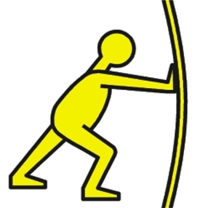
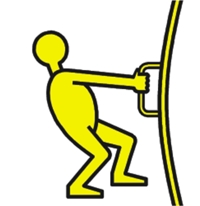
    I’ve been doing a little reading on the art of design and the failure of art as design.  (For example, see this piece about how objects for human use should be designed for, you know, humans.)  That led me to the International Push/Pull Pictogram Design Competition, tasked with designing exactly what it says: a non-verbal universal symbol to indicate which way to move a door to open it.  Some of them are awfully inspired and some of them are just awful.  But the “winner”, I feel, simply replicates the problem:

    A pictogram of a yellow man pushing.A pictogram of a yellow man pushing.

    Quick: Which of these says “This door opens by pulling”?

    I would argue that you can make a case for either one.  The person on the right is clearly pulling, so maybe that means “Pull this door”.  But the door is bulging outward — which says, to me, that the door is not cooperating — it isn’t opening — and so you shouldn’t pull, you should push.  (Likewise, the person on the left is clearly pushing but the door isn’t opening; maybe pushing isn’t the right choice.)

    The judges picking the winning logo gave the following explanation (in part):

    The push symbol is as if the figure is pushing a car and the pull symbol is a figure pulling as if in a tug of war. For extra clarity and to give the impression of force and movement, the doors being pushed and pulled are bowed-shaped.

    But in so doing, they fell prey to the same problem they thought they were solving:  The pictogram needs to be explained, so it is neither universal nor obvious.

    Personally, my choice would have been the one to the right of the upper-left corner of the submissions:

    pushpull

    This is unambiguous as to how the door moves.  It also serves as a nice warning that the door opens outward, in the second case.  (There was a similar one with hands but I think that is too specific:  The door opens inward whether you pull it or someone pushes on the other side.)

  • Miracles and Wonder

    Miracles and Wonder

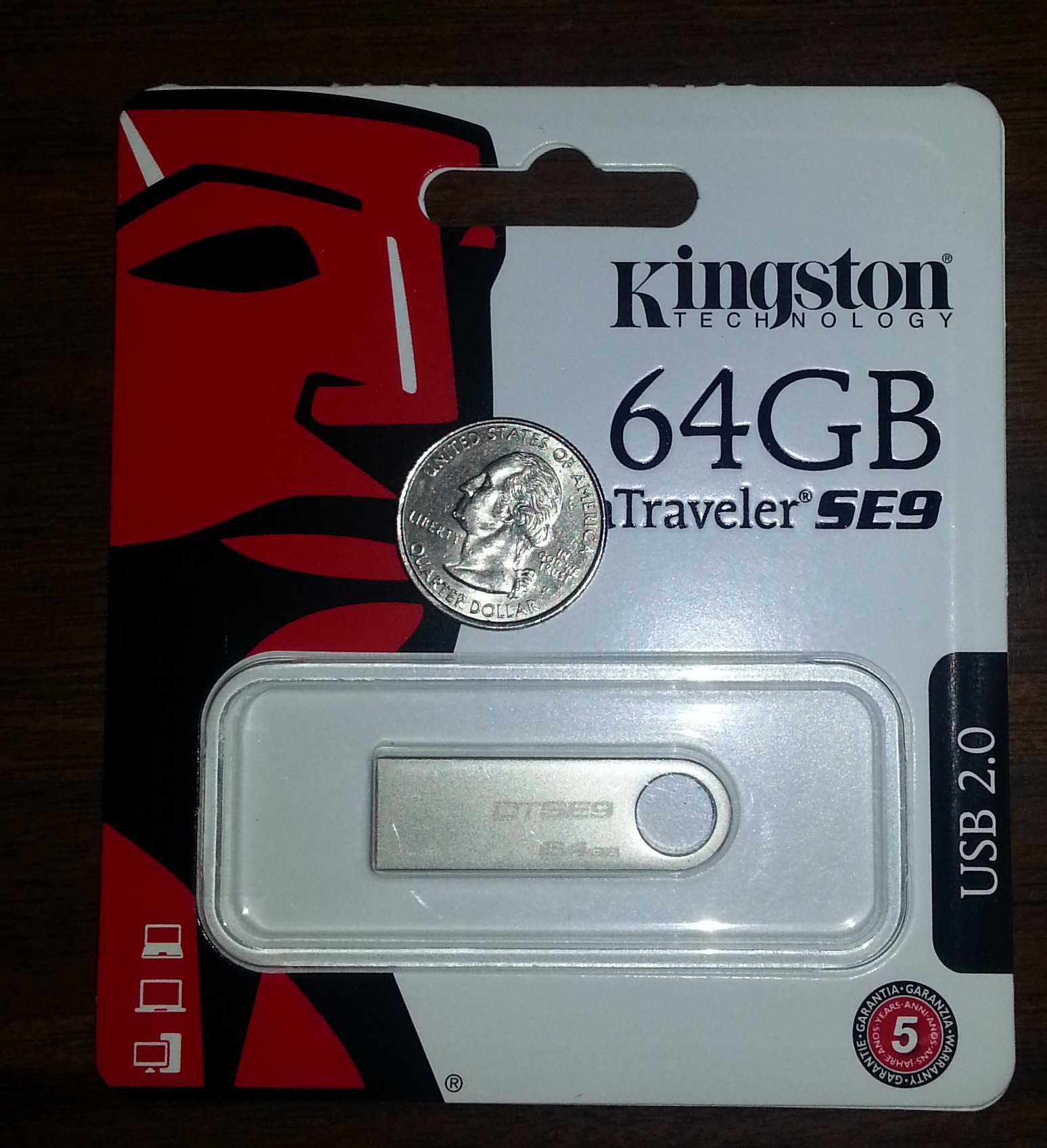
    2013-08-14 15.04.38 I just received the Kingston 64 GB USB flash drive shown above.  It holds (duh) 64 gigabytes of data.  I’ve included a US quarter for size comparisons. My first computer was a Commodore-64, for which I had the venerable C1541 floppy disk drive. That used 5.25″ floppy disks — which were actually floppy, you could bend them (though that was not advised!) — and could cram as much as 165 kB onto each one. Yes, that’s kilobytes. This means that, to hold the same amount as the flash drive, I would need something like 406,721 floppy disks. Laid end-to-end, they would stretch about 33 miles, or half again as long as you’d need to bridge the English Channel. Laid out in a square, they would cover an area of about 1.8 acres or 1.44 (American) football fields. Stacked, they would stand 650 m tall, or about 1.46 Empire State Buildings. A single floppy disk cost about $2.25 (when purchased in bulk, and we would obviously have to do that!). So the cost to own this much storage would be about $915,120. We probably shouldn’t neglect you’d have to buy the drive as well — that would add $400. OK, we probably could neglect that.  Oh, wait. That was in 1982. According to the Inflation Calculator, $915,520 in 1982 would be equivalent, more or less, to $2,144,035 in 2012. (Information not available for this year yet.) I paid amazon.com the princely sum of $37. And got free shipping. (And don’t need a warehouse to store my 400,000 disks!) My point? We live in an age that would leave Scheherazade a-gasp and disbelieving. We live in an age of miracles.

    Also, get off my lawn.

  • Life Goes On (30 Days of Marc Cohn — Day 11)

    “Life Goes On”
    Join the Parade

    This is one of those pop songs that have a catchy melody but when you stop to listen to the words, you say, “Wait, what?” It’s a pop song about dying, but it’s surprisingly upbeat. Marc is a little brutal here. Life goes on, no matter what we lose: Elvis, Jesus, your mother, your father, all your siblings. It just goes on. Indeed, it’s a bit relentless and uncaring: It just goes on, oblivious to our tears and our losses and how much it hurts to go on — and it doesn’t even miss a beat. (“Without your children down the line / The drum stays right in time).  It’s worse than that, actually.  Life won’t even notice when you pass: You might think it’s gonna stop just because you’re closing shop… Life goes on… Life goes on…

    I’d like to say that there’s a hopeful end to the song but really, it’s pretty bleak.  I suppose there’s a comfort to be had in the implacability, the eternal renewal of life, but it’s thin soup.

    Aside:  I generally love Marc Cohn’s songwriting but every once in a while, he puts out a clunker of a line.  In this song, it’s “Without the beggar or the King / Without every living thing. / Yeah, Life goes on.”  Um, without every living thing, life would not go on… there’d be nothing alive.  The line would scan as “without any given thing” and work better logically.


  • De-tuned

    I wrote this nearly five years ago.  I was mad then; now I’m more or less just resigned.  The intellectual commons is being fenced off, now more than ever.  I think we’re losing more than outlets for creativity or profit; we’re losing the shared language to remember who we were, who we are.

    ==============

    De-Tuned

    Recently I’ve come to feel under assault.  Not in my person but in my past.

    One of the guilty pleasures of my childhood was a TV show called The Greatest American Hero, which I adored when I was twelve.  For those not fully up on their Reagan-era television trivia, the show involved an ordinary guy — a school teacher, in fact — who was given a “supersuit” by friendly aliens in a Close Encounters-type flying saucer.  The suit, a ridiculous set of red long underwear, empowered Ralph the teacher with powers reminiscent of Superman: flying, strength, immunity to bullets.  But unlike cool and collected Clark Kent, Ralph Hinckley has all the usual foibles of humanity: he can be frightened, angered, made jealous.  Moreover, he loses the instruction book and has to figure out the suit on his own.

    In my memory there has always stuck out one particular episode, called “Operation: Spoilsport“.  (I have since learned the title; at the time, I was not the type who appreciated the importance of titles to works.)  It marks the return of the “little green guys“, who warn Ralph and his FBI partner Bill about the impending destruction of the Earth.  Probably to make the aliens seem mysterious and transcendent, the writers decided that they could speak to Ralph only by adjusting the car radio so as to catch little snippets of regular broadcasts that, put together, made up the message.  Even at the time this struck me as a clever trick to make the aliens sound, well, alien.

    Here’s where the assault comes in.  To bring home their point — to underscore the stakes — the aliens keep sending Ralph the same song over and over.  From 1982 until recently, I had thought that the song was “Eve of Destruction“, a song by P.F. Sloan that Barry McGuire took to a place on the Billboard charts in 1965.  I was 12.  I hadn’t ever paid attention to 1960s music.  The Viet Nam War was, at best, the source for action movies like First Blood.  I knew about Red China but I almost certainly didn’t know why Sloan would compare it to Selma, Alabama.  In short, the song should have been, to me, a jumble of confused rage directed at outdated cultural references that had no meaning for me.

    I was only 12.  But it was 1982, two years into the Reagan presidency.  Six months earlier the President had nakedly called the Soviet Union an “evil empire” and made undiluted opposition the cornerstone of his foreign policy.  The New York Daily News had published its periodic map of the city, showing the hypothetical effect of the latest Soviet warhead if it were to be detonated above the Empire State Building — cryptic squiggles and broadly-drawn circles whose radii indicated just how far away you had to be to escape each of the various killing zones: the immediate blast region and the flash-immolation zone and the merely concussive damage area.  Everyone simply knew that World War III was on its way, that it would start with a Soviet invasion of West Germany, and that it would end with, well, The End, capital “T”, capital “E”.

    Small wonder, then, that I found myself morbidly drawn to this song with its rough-hewn, unworkable, unrelenting refrain: “Tell me, over and over and over again, my friend, how you don’t believe we’re on the eve of destruction”.  Small wonder, perhaps, that I found comfort in the thought that maybe, out there somewhere, was an ordinary high school teacher in a ridiculous suit of red long underwear who could step in and save the world.

    Time passed.  The Soviets never came over the North Pole, or from Cuba, or even from East Germany.  Reagan went to Reykjavik and then to Berlin (“Mr. Gorbachev, tear down this wall!“).  I went to high school and then to college and then to grad school.  The Greatest American Hero went to reruns and then to syndication hell and then to oblivion.  Everybody forgot that at one time everybody had known that World War III was imminent.  There was peace, for a time, and there was prosperity, for a time, and there was security … for a time.

    Then they were gone, and everyone — whether they knew it or not — was humming the refrain from Barry McGuire.  I found myself doing it consciously from time to time.  I took some obscure hope in remembering how eerily prophetic it had seemed in 1982 and in how its prophecy had utterly failed to come to pass.  From my more nuanced vantage I knew now that McGuire was singing more of the raging undercurrents of hate and mistrust that spawned the violence of the Sixties, and I even recognized that that river still ran strong and deep in human affairs.  But it was a piece of my youth, one of those signposts along the way toward maturity.  “Eve of Destruction” had been, through the medium of The Greatest American Hero, part of the soundtrack of my growth from the simplicity of childhood toward the complexity and shades of adulthood.

    Or so I had thought, for two decades and more.


    Eventually, Anchor Bay Entertainment released, after many delays, the DVD set of the second season of The Greatest American Hero.  Episode #2 was “Operation: Spoilsport”.  I opened the box and jumped to that episode immediately.  I reveled in the guilty pleasure of being a twelve-year-old proto-geek again.  It was everything I remembered — until the end of the second act.  The little green guys returned, they futzed with Ralph’s radio, and out came… some random manufactured pop hit.  Where was Barry McGuire’s gravelly rage?  I rationalized that I had misremembered.  After all, there were several instances in this episode when they sent Ralph a song.  Probably the writers had built up to “Eve of Destruction” and then I, struck by its power, had expanded it to fill the episode in retrospect.

    Three more acts came and went.  Three more quasi-pop songs too upbeat for their faux angst.  No Barry McGuire.  No “Eve of Destruction”.  It was the final act and there was only one more opportunity for the green guys, and now it wouldn’t even make sense — the crisis was past.  Suddenly, the end credits rolled.  I wondered if I was crazy.  Before playing the disc, I would have sworn in a court of law on a stack of Bibles that the key song from “Operation: Spoilsport” was “Eve of Destruction”.  Had I gotten my wires crossed?  Perhaps somewhere in the past twenty years I had come across “Eve of Destruction” and subconsciously recognized its appropriateness, then pasted it retroactively into my memory of “Operation: Spoilsport”.  If the human mind was so malleable, if I could unknowingly alter my memories so thoroughly — well, the world was suddenly a much scarier place, and not just because of Soviet nukes.

    Before checking myself into a mental hospital, I did a little bit of research.  Only a few minutes online brought me some confirmation of my sanity.  If I had invented the insertion of “Eve of Destruction”, at least I was not alone in my delusion, because several different message boards were aflame with people indignant over its removal.  The true story was simple and, a propos for the times, more base:  money.

    The Greatest American Hero, it turns out, was ahead of its time a little in that it incorporated “regular” music deeply into the storylines — a tactic used to more lasting impact on Miami Vice a few years later.  Because it was a pioneer, the show’s creators never thought to secure reproduction rights for home collections.  In 1982, nobody could buy an entire season of a TV show and certainly nobody thought anybody would if offered the chance.  Everybody “knew” that when a series ended, its appeal vanished and its money-making chances went as well.  Just like everybody “knew” that World War III was just around the corner.  Today of course the home market represents the lion’s share of revenue for a project and no one would forget to purchase those rights.

    Anchor Bay faced two options:  Pay for all the songs again and raise the price (and cut their profit margin).  Or splice in generic songs to which they had the rights, and hope nobody would notice.  Judging from the vitriol flowing online, they made the wrong call.  And I have to admit, I share the anger.  Quite some time has past since I discovered the substitution, and it still rankles me.  I’ve been trying to figure out why.  After all, it’s just a TV show and — I have to admit — not really the best one, either.  It’s campy and goofy; the situations ludicrous and the characters cardboard.  While I’ve always had a soft spot for The Greatest American Hero, I’ve never considered it my favorite show nor even among the best.  Why would it inspire a slow-burning anger at its modification?

    But of course it’s not the modification of the show that inspires the anger.  It’s the mutilation of my memory.  Precisely because the writers had woven the music into their story, it couldn’t be simply spliced out.  A purpose of art is to evoke change and response, and clearly, that episode had attained that purpose, at least for me.  “Eve of Destruction”, learned by me in that particular context, had played a part in the formation of the adult me, of who I became, of who I am.  Now it had been callously and carelessly removed, edited out in a creepily Soviet fashion.  My memories, my past, were not out of bounds, it would seem.

    The whole affair has given me a better insight into a different work of literature.  Without any intention by Anchor Bay, they gave me just a taste of Winston’s life in 1984.  Big Brother wasn’t out to rule the world, here, but Big Brother Incorporated didn’t mind trashing the past to make a quick buck.  What’s more, there seems to be a growing use of and a growing acceptance of this sort of media revisionism.  We are losing any idea of a shared cultural base.  The cultural commons are being carved up and fenced in.  But a person’s identity is myriad and shared, and cutting up the commons means carving up ourselves.  Soon we could just be atomistic stubs bouncing off the walls we erect between us.

    Think on that and then tell me again, my friend, if you don’t believe we’re on the eve of destruction.

  • Turn on Your Radio (30 Days of Marc Cohn — Day 4)

    Turn on Your Radio
    Burning the Daze

    This is a very gentle song you might expect to hear winding down an evening. It’s got a catchy refrain which I find myself humming.  It also ends with a somewhat-strange coda:

    Everybody had a hard year
    And everybody had a good time
    Everybody had a wet dream
    And everybody saw the sunshine

    Everybody had a good year
    And everybody let their hair down
    Everybody put their socks up
    And everybody put their foot down

    I don’t know what it means that “everybody put their socks up”…

    (Aside: It was pretty apparent from the first listen that this is a cover of someone else’s earlier song.  It turns out that someone else was Harry Nillson, whom Wikipedia tells us was  an American singer-songwriter who achieved the peak of his commercial success in the early 1970s”.  I have my doubts about how high the peak of his success actually was, as I had never heard even a mention of him.  So I checked out his discography and realized that, no, I really haven’t heard anything by this guy.)

    (Second aside:  I feel like I’m on the very edge of cheating. posting this at 11:57 PM.  I suppose technically it’s still “Day 4″…)


  • The Calling (30 Days of Marc Cohn — Day 3)

    The Calling (The Ghost of Charlie Christian”)
    Join the Parade

    This is a song that sort of snuck up on me.  I first heard it in concert (in at least 2007, though I think it was earlier), and it initially underwhelmed me.  The guitar is amazing, but that’s Shayne Fontane and to be expected.  It was haunting enough (being part of the Ghost Quartet) but didn’t grab me.

    Or so I thought.  Because within a few days of receiving Join the Parade, I found myself humming the refrain at odd moments.  Apparently it worked its way deep into my hind brain, because I continue to return to it.  I can’t say that the lyrics speak to me much but the melody really does.  It probably doesn’t help that crossed circuits in my brain map “Charlie Christian” into “Charlie Wilson“.  Though I have always felt that Marc Cohn has a place in an Aaron Sorkin soundtrack.  🙂

    Oh, by the way, Charlie Christian was apparently a swing guitarist credited with helping transition the guitar from a part of the rhythm section into a solo instrument in its own right.

  • Giving Up the Ghost (30 Days of Marc Cohn — Day 2)

    Giving Up the Ghost
    Join the Parada

    Appropriately, this is a very haunting melody.  It’s a ghost story, of course.  As is usual for Marc Cohn, it’s also an extended metaphor for a relationship in trouble.

    She gave me something I needed but now the feeling is gone
    And it’s high time I told her she’s gonna have to move on

    This is someone whose life has intertwined with his over the years.  They’ve gotten together, broken up, and fallen back together again.  She probably enters his life at the low points, when he’s looking for something familiar from his past, and even though he knows it’s going to end badly, he finds himself drawn over and over into her orbit.  This can wear hard on a person.  (There’s a nice and very subtle nod to superstitions that ghostly visitors can drain your vital energies away, using up your life trying to regain theirs.)

    From the eerie lake to the hills that shake
    I’ve been haunted on every coast

    This can be seen as brillant, once you recognize that Marc Cohn grew up in Cleveland (on Lake Erie) and spent formative time in California (the hills that shake).

    Last night she came in at the usual time
    Twelve is the number that the church bells did chime

    This couplet, on the other hand, is a real clunker.  It just falls flat.  It’s probably the reason this song  is so low on my top-30 list.

    Now I’m feeling much better
    But I’m still on the brink
    I just got a letter in vanishing ink

    It’s a really strong finish, lyrically, even though the song “fades to black” without a climax.  This is just impressive.  Clearly, even though he’s let her go, she isn’t letting go of him:  The resolution implied in the refrain is far from final.  And of course, associating letters from ghosts of your past with vanishing ink is tremendous.  It’s even better if you assume the letter was full of “I love you forever” and other endearments meant to win him back… because the vanishing ink makes clear that such sentiments are, despite the protestations, doomed to fade.


  • 2013

    I don’t do resolutions. But I do intend to write more regularly in the coming year.