And, who’s looking out for the Insurance Companies?
Category: teaching
-
Week 34 in the Program
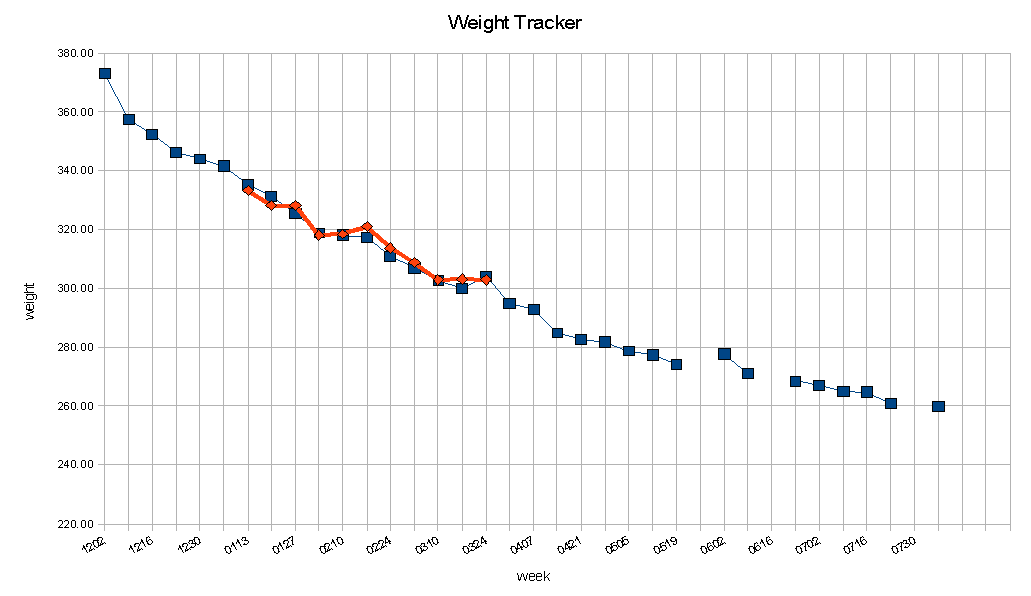
Weight this week | Change since last week | Total change 259.8 | ? | -113.2 OK, I should have posted this nearly a week ago. But it’s been a whirlwind and I just couldn’t get to it. Surprisingly still on track, despite my trip to California. I had thought I’d gain some, since my exercise was irregular and my attention to the plan spotty at best. But in fact I continued a weight loss, albeit a small one. We’ll see if the weeklong roadtrip to DE and MD had any different effect…
-
Week 28 in the Program
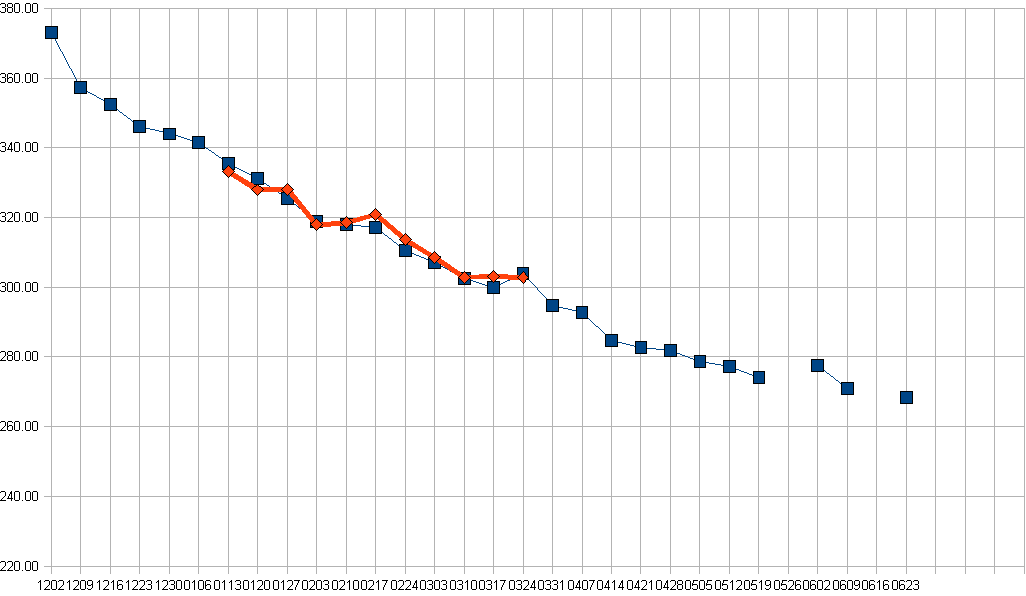
Weight this week | Change since last week | Total change 268.4 | -2.6 | -104.6 Not that much to note. I’m back on track and feeling good about it. Soon I’ll be switching to Thursdays instead of Tuesdays for the weigh-in, so that will glitch the weekly numbers a little.
-
The Start of Summer
Everyone has their own unique signs that summer is upon us, the signature sound that signals the academic year is winding down. For me, it’s “Everybody Wants to Rule the World” by Tears for Fears.
More below the fold.
(more…) -
Lunacon 2009 (2): Friday late night
One of the fun things about cons is that they go on and on into the late night (at least by my standards). I went to a couple of late-evening sessions last night: “Strangers Have the Best Candy” and “Adult Filking”.
(more…) -
The (non) Importance of Caring
A former student of mine at some point had a facebook status that read,
Why should I study something I don’t care about? Why should teachers teach something they don’t care about?
Actually, to be 100% accurate, the student’s status said that this was in someone else‘s status. But still…
“Why should I study something I don’t care about?” is a question that sounds more reasonable than it actually is. Where you are at 17 — or at 5, or at 38 — is not who you will be your whole life. Sometimes, indeed often, you don’t have the experience or wisdom to know what’s important. (This is a generic “you”, not a some-particular-student “you”.) And sometimes, to get to the good stuff, there really is other stuff you have to go through or learn. That’s a part of life. I’d even argue it’s not a bad part of life. Things you learn should be meaningful, and that meaning should be clear. But you aren’t done, yet, and what you care about is simply not the whole total of what’s worth knowing or doing. It isn’t for anybody.
I guess fundamentally I disagree strongly with the proposition that “what I care about” is synonymous with “what is important”. There’s an arrogance in that which is every bit as haughty and unjustified as the “We’re the teachers so we decide what is important” tack. It’s so inward-focused it’s very nearly solispistic.
To be fair, I am somewhat assigning motivations on the assumption that the point of asking “Why should I study something I don’t care about?” is to offer as an answer “You shouldn’t”. If the question is a legitimate call for information, it’s perfectly valid. Students should demand to know why they are studying what they are asked to study, how it moves them along toward their goals or what it achieves. Teachers should continually ask (themselves and others) why they cover what they do. So as long as the questioner is intellectually honest enough to be open to the possibility that there could be things worth studying even if the questioner doesn’t particularly care about them — as long as that’s true, it’s a good question.
-
America the Beautiful
A stirring rendition, courtesy of Beyoncé at HBO’s “We Are One” Inauguration Concert.
-
McCain’s VP
So, Senator John McCain has chosen Sarah Palin, governor of Alaska, as his running mate.
Wow.
It’s taken me a while to get my head around this. Sarah Palin is a political neophyte — if your main charge is that Barack Obama is inexperienced, then you have to see Sarah Palin as INEXPERIENCED. All of her avowed positions are far far to the right of mainstream American opinion. It’s impossible not to believe that the campaign picked her in a blatant attempt to pull off a cynical two-fer: (a) The ultra-right goes ga-ga over her ideological credentials; (b) low-information “Hilary die-hards” decide to vote against everything Senator Clinton believes in so as to get a woman — any woman, dammit — into the executive wing. The latter part is so blindingly obvious that, I think, the only people who will fall for it are people who would have found some reason to vote for McCain anyway.
What to do? How to react? The Obama campaign has a lot of people way more plugged in than me, but below the fold, I give my two cents:
(more…) -
Throwing Out the Textbook (Part II)
(Part I gives the background.)
Since the date to order a textbook has long since passed, I’m pretty committed to not going with one for “Space Science & Astrophysics”. I’ve taken the plunge. The problem is, I don’t know exactly what the course should look like now. Most especially, I don’t know of a good way to evaluate the students. I do not want long papers to grade every week! Also, although Scientific American articles are written for “the intelligent layperson” and so should be within the reach of 12th graders, there won’t be the same organized, coherent narrative that a textbook can give. In other words, when you know that you’re going to cover tides in detail in Chapter 5, you can arrange Chapter 3 more intelligently.
I won’t have that luxury. It would seem that that would lead to more lecturing, a proven-bad way of teaching. I will have to lecture somewhat but I want to minimize how much. One thing I’ve considered is throwing it back onto the students. There are tons of sites dedicated to popular astronomy and astrophysics. Perhaps I can give them weekly worksheets with terms and ideas they need to research. Certainly class participation is going to carry a lot more weight than usual in my class, because a lot of what we handle is going to have to be tailored to what they bring to discussion. There will almost certainly be papers of some sort. I am also considering weekly quizzes just to ensure that people have read somewhat. Finally, each quarter will conclude with some sort of group project/presentation. What’s worked well in the past have been things like The Pluto Prosecution as well as a detailed project on Exobiogenesis.
An intriguing possibility is that I will have functioning laptops for each student. This opens up the chance to do actual web-based instruction — but what would that look like? How can it be used to enhance the course? Most especially, web-kits often take a lot of time to develop, and I’ll be doing this largely seat-of-my-pants.
What has me concerned most is tests. How much objective stuff can I put, when their sources are likely to be wildly divergent? And what would be the most effective way to assess the objective content? For the past two years, I’ve used a mixture of multiple-choice and fill-in questions, and (I have to admit) I’ve been immensely dissatisfied with both.
So… anyone have any thoughts on how to assess this class? All suggestions will be deeply appreciated.
-
Throwing out the Textbook (Part I)
(You can skip to Part II.)
Some of you might remember that this is nominally a blog about education. It’s time again to shunt aside all the personal and political things I like to blog about, and to instead post about my classes. I do this in part because school starts soon and I am still up a creek regarding one of my classes, and thought that the great wide Internet community might offer some ideas.Here’s the situation: For the fifth semester I will be teaching “Space Science & Astrophysics”, a 16-week overview of the discipline intended for seniors at my prep school. Due to the vagaries of our curriculum, many if not most will be taking this course to complete their science requirement — and hence will not have taken regular HS physics beforehand. For the past two years I’ve used The Cosmic Perspective by Bennet, et al. (I’ve been using 4th edition but I see they’re up to 5th now.) I really liked the book, actually, and still think it’s a fantastic textbook for its audience … but its audience is not survey-level 12th graders many of whom have not had physics. As I observed even my best students falling behind in the reading, and as I considered the $125 price tag, I grew guilty and frustrated. So I decided to shake things up.
More below the fold.
(more…)