Today is the 19th anniversary of my inception of this blog. I haven’t written as much as I’d hoped to, nor as regularly, but all in all I’m still happy with it.
Category: Writing
-
Facebook recaps
As usual, I told myself all Spring Break that I should be writing more. Then I realized that I output a noticeable amount of musings, rants, and thoughts — not a flood, but at least a trickle — on Facebook and other social media. I’m going to go through and pull out the longer or (in my opinion) more noteworthy posts and repost them here on Mongrel Dogs. Because self-plagiarism is by far the best kind of plagiarism.
-
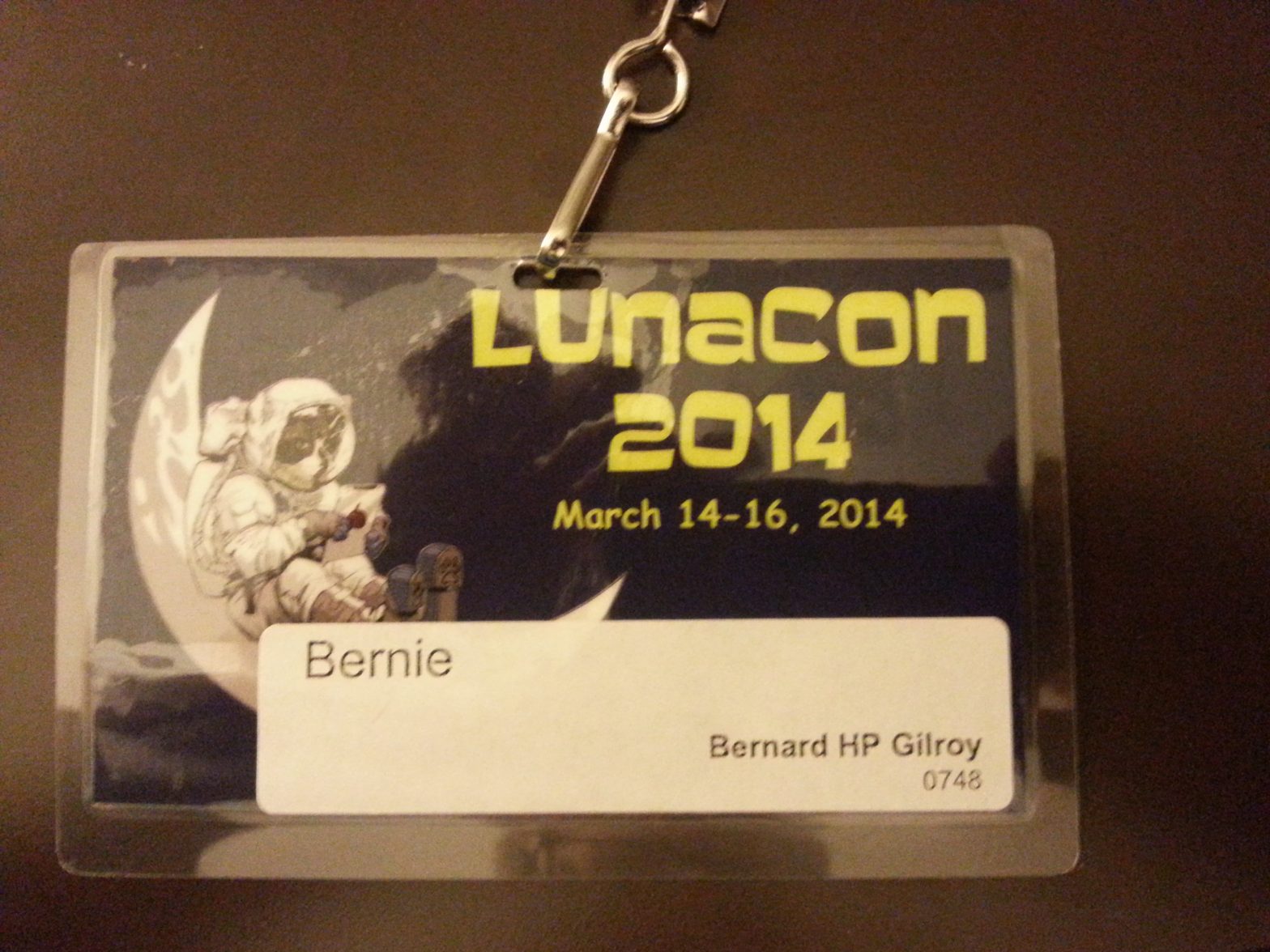
Lunacon 2014 (2c): Reading by Merav Hoffman
Saturday 12 Noon
Panelist: Merav Hoffman (duh)
I don’t attend a lot of readings, because I generally prefer reading things at my own pace. I don’t find the timbre of the author all that engaging. On the other hand, Merav was a very welcoming presence at my first Lunacon and I wanted to make sure I at least caught her to say Hi, and this seemed a good time to do so.
I came in at the tail end of someone else’s reading, and I can’t really comment on it. Then, after a few minutes’ break, Merav asked us “Dogs or elephants?” Apparently she writes childrens’ stories and had two ready to go. The common consensus was, dogs.
Ironically, she then read a story of hers called (I think) “Circus”, but it wasn’t about a circus, it was about a dog named Circus. (It did also have acrobats in it.) It was sweet and simple, and flowed really smoothly. I was reminded of the Bard writing group at Hun, back when that was a going concern. (Part of me wonders if it would be worth reviving in some form.)
After “Circus”, she also read a reinterpretation of Rapunzel, or rather, a sequel of sorts. Almost as an aside, Merav mentioned that the origin of Cinderella lies in a story from China, which I had never heard.
A propos of nothing, I also have to comment on the surreality of the con: While Merav was reading about Rapunzel, a troop of Star Wars stormtroopers loped past the open door.
-
Lunacon 2014 (2a): Altering Time and Perception
Saturday 11 AM Odelle
Panelists: Walter Hunt, David Sklar
This was not especially well-attended: at first, just the panelists and me. By the end, another 6 or so people had shown up. First panel on a Saturday is probably a dead zone.
There were really two topics to be discussed:
- How is a story paced?
- How do you elide the unnecessary details while avoiding info-dumps?
As an example of an author messing with time sense well, one panelist offered up Dirk Gently’s Holistic Detective Agency. The other came back with Slaghterhouse Five. I thought of Catch 22.
My personal observation: We are very much a cinematically-informed people now. How can you evoke the equivalent of time-lapse photography or bullet-time effects?
- Interestingly, to convey speed, it’s important to avoid detail.
- You might plot out every intricate movement in the sword fight, but long paragraphs slow down the reader’s time sense.
- Short but evocative phrases can heighten tension.
- Creative use of punctuation can control time-sense too.
- Indicating jumps in time without explicit title-carding is possible but tough.
- For longer jumps, you can use subliminal clues, such as mentioning that a city is inaccessible except by boat in one period, then commenting on the new railroad opening in another.
- Sometimes you can use fashion or manners to indicate the discontinuity.
- It can be helpful to encounter the older versions of characters from earlier in the timeline.
- How do you ensure the reader doesn’t get lost? Or how do you lose them constructively, if that’s the point?
How do you signal (to editors or readers) that you’re making a stylistic choice and not just being lazy?
-
Lunacon 2014 (2b): Write What You Don’t Know
Saturday 12 noon
Panelists: Walter H. Hunt, Laura Anne Gilman, KT Pinto
Sadly, this was not (imho) a very successful panel. The panelists talked around the topic but never addressed head-on how to avoid the pitfalls of writing about things you haven’t experienced. Walter Hunt mentioned that he’s spent a lot of time volunteering at a living farm and so sees a way of living most of us can hardly imagine. The panelists bemoaned the writers who treat horses as simply breathing automobiles.
One thing I hadn’t thought about was, how do you write likeable characters from an unlikeable time? Historical fiction set in 1802 New Orleans can’t really avoid the whole slave question, and indeed, your hero is likely to know slaveowners or be one himself. It’s unsatisfying and a little flat to make all your protagonists be modern, liberal, open-minded people who happen to be centuries ahead of their time. Unfortunately, the panel didn’t really offer any insight into what to do about it.
A different, related difficulty is, how do you avoid having your readers think that you, the author, agree with the objectionable mores of the era in which you set your book? If your hero does not inveigle against slavery (possibly because he grew up a plantation owner’s son), some might see that as tacit approval on your part. The published authors seemed to agree, there is no way to avoid this completely. It just comes with the territory.
I made a personal discovery, to wit, once someone mentions the vampire story they wrote, I just tune them out. It isn’t fair but I just don’t respect that genre. In my defense, every single instance it occurred during this Lunacon, my disdain ended up being justified.
-
Lunacon 2014 (1b): Alternate Technologies in Historical Fiction
Panelists: Russ Handelman, James Cambias, Paul Calhoun
And here he is, That Annoying Guy From One Seat Over. This archetype shows up at every con, like a restless spirit.
One of the panelists pointed out that, more or less by definition, this would actually have to be about alternate historical fiction.
Examples of a missed technology:
- Handelman: Could steam locomotives have happened 50 years earlier?
- Cambias: Once you have cloth and fire, you can have balloons. Why did they wait until the 18th century? (Some people think the Mesoamericans had them.)
- Calhoun: complex calculators like the Antikythera Device.
All in all, Calhoun was far and away the least effective panel member.
Technology needs a use before it will be adopted. Muscle power is effective and cheap — you only get machines when the application is impossible or expensive to do with muscle.
Technology that disrupts existing power structures will be resisted by the people in charge of those structures. Until the modern age, societies were not tolerant of that disruption, so change came very slowly. If you want an industrial revolution in ancient times, you’re going to have change the form of antiquity.
Handelman mentioned a book called The Most Powerful Idea in the World, which posits that the Industrial Revolution occurred in England because the English had invented patent law. I wonder if the century of civil war and ongoing disruption was also vital.
Then, there was a fire alarm and we had to flee the building. That cut the session short.
-
Lunacon 2014 (1a): Building Character
Panelists: Mike Flynn and Ken Atlabef.
I was a little disappointed to see that the first panel sported Mike Flynn as a guest. At the last Lunacon, Mike Flynn was the moderator for the panels I consistently liked least. My recollection was that he was a know-it-all who made points only to emphasize his intelligence or to plug his own books, and that the expertise he claimed did not jive with my own knowledge in those areas I had actual expertise in. To be fair, at this panel, he was much more witty and, since it was a writing panel, a lot more effective. He did continue to make it all about him, although it turns out, he can be pretty funny.
The first thing I noticed is how old the audience skewed — I might have been the second or third youngest person there, and I am no spring chicken. This might owe to it being the very first panel to open (before they’ve even set up registration!); maybe only geezers can get away in the mid afternoon on a Friday. 🙂 However, looking over the whole evening, it does seem that Lunacon is trending gray. More on that later.
The title of the panel was a play on words. Rather than moral education, it was about how to craft characters that people will care about and that have the strength to carry your story.
The two panelists did make some really good observations, which I think I’ll find useful when I ever wander back into writing fiction. In no particular order of importance:
- Most sci fi is plot-driven. Other than sci fi, most modern fiction is character-driven. This is probably why sci fi fans complain that other works drag or seem to be about nothing.
- It’s important that characters be true to life. “True” here doesn’t mean factual or literal. True-to-life means that the characters act in ways that make sense to the reader.
- The star of Lord of the Rings is Middle Earth itself. Tolkein didn’t write a story so much as a travelog.
- Altabef felt very strongly that you need to “profile” your characters fully before writing them. He came back to this several times.
- They need to have a back story and you need to know it.
- You must create as much detail as you can.
- But you should reveal only the “telling details” — the ones needed to move the plot or to define the character.
- It’s OK to surprise the reader later but you should never be surprised.
- That’s what a first draft is for — to uncover the ways your characters will surprise you.
- Flynn felt that, when you introduce a character, you should provide the reader with a physical image as soon as possible with as much definition as possible.
- Don’t write stories about ghosts (unless it is a literal ghost story and your character is a literal ghost).
- The character should be doing something that reveals who he is. Think Indiana Jones, who is being Indiana Jones — whip cracking, cautious, observant — within 30 seconds of appearing.
- Dialog is the way you reveal and explore your characters.
- Every character should sound like a person. They should not sound like the same person. 🙂 A note for Aaron Sorkin, I suppose.
- You can flesh out dialog (and break its monotony) with eye movement, facial expression, tone of voice.
- A good writer is observing people all the time and noting their distinguishing tics, mannerisms, etc. You should constantly observe people to try to figure out their motivations — getting them “correct” is less important than the exercise of coming up with them.
- There’s a writing exercise that occurred to me that I want to try: Come up with a situation or piece of conversation and re-tell it for each character.
- Every character should sound like a person. They should not sound like the same person. 🙂 A note for Aaron Sorkin, I suppose.
- Character flaws are useful hooks.
- It’s best if the character’s flaw has something to do with the actual story. 🙂
- It’s imperative to avoid Mary Sue syndrome.
- One technique: Assign each character their Myers-Briggs score, then put them in a situation where they have to act against it. Use that discomfort.
- Villains
- No man is a villain in his own eyes.
- When possible, include an anti-flaw — a redeeming quality — to avoid the Punch Clock Villain problem. Unless that’s what you’re going for, which is OK in its own right.
- Generally, don’t have the villain do it for the evulz.
- A truly great villain leaves the reader unsettled, because he/she demands sympathy or at least understanding.
Then the group degenerated into discussing Batman. Of course.
-
My philosophy of education
Edited to correct some grammatical mistakes.
The new school year is about to start, and it’s customary to take a moment and philosophize. But I’m really busy, so I’m going to dust off something else and let that stand in. Back in 2010 December, I was nominated for a prize offered by Princeton University Teacher Prep. Part of the process was to submit a statement of my “philosophy of education”. I’d never actually put down on paper my educational philosophy, so I had to write it fresh.
I didn’t win the prize 🙁 but I did get to spend some time thinking about why I’m doing what I’m doing. That’s worthwhile. And since I was once instructed by a very wise professor that anything worth writing is worth using at least three times, I figured I’d recycle my statement here. Enjoy.
-
The Burning Moment
or, Mikey’s Last Night
I’m scared now.
Everyone is scared now — they’re scared of me because of something I did, and now they look at me with new eyes, and I’ve caught their fear the way I’ve caught their scent. I can’t hear Little Little crying anymore, but that’s because Big Lady and Little Little are gone. But I know that Little Little is crying, somewhere, and it’s because of what I did, and the memory of her crying is breaking my heart. And breaking my heart, too, is Old Lady, who is sitting on the fluffy bed and weeping. I love Old Lady; she gives me treats and rubs my belly and grooms my fur, which I love even though I pretend it kills me. And now the Old Lady is weeping for what I did, and that is killing me. I love the Old Lady, I have loved her my whole life, and now she is weeping because of me.
I can’t remember.
I don’t know what Little Little did that brought on the burning moment. Maybe she didn’t do anything. Maybe this was just something inside of me. Maybe it’s always been waiting to get out. Everything’s been so jumbled lately. Nothing’s been the same since the Big Ride. Patty and I love to ride, to get out into the world and see it rolling past the windows like magic. But this Ride was different, so long, so long. After a while it seemed like we had lived our whole lives in the car, escaping only briefly each day on the leash, jetting outside to do our business and then back, until that night’s motel and the tomorrow’s ride. And when the Big Ride was over, we were somewhere else, not home, not in our usual world. Somewhere big and open and dry.
We never went home again.
I don’t know why, but Old Lady took us away from Loud Old Man — which was no loss at all — but she didn’t go home. She took us somewhere else, even hotter, even drier. And then another Big Ride past all the world that we didn’t know, to somewhere that wasn’t home. Things are shaped wrong here. They’re not like I know at all. Things are too cramped, and too tall. The air smells different. But that doesn’t matter, because there was no Loud Old Man, and there are children — Big Little and Little Little, who takes care of Lucky and took in Patty and me. Big Little gives us treats when she thinks Old Lady isn’t looking, even though Old Lady is looking and just smiles. Little Little plays with us all the time. Old Lady is happy and so is Big Man and Big Lady. This isn’t home but it was even better.
But I did something.
Patty lies on her bed, whimpering and watching me, and Old Lady is weeping, and Big Little doesn’t know what to do. She holds Old Lady’s hands, and then she walks away, and then she runs upstairs, into the big house that isn’t our house. And then she comes back down and holds her hands again. They’re all so scared, and I want to waddle over there and nuzzle Old Lady and comfort her, but I can’t, because they’re scared because of me. I did something, something that made Little Little cry and bleed and Old Lady weep. Something that I know is wrong, that I knew was wrong when I did it, and I can’t take it back and I can’t make it right.
The burning moment just came.
I don’t know why I did it, I didn’t want to do it, I want so much to have not done it. The burning moment just came and it took me. My jaws and my teeth did what they’ve done my whole life, what they’ve made to do, what it’s right that they do. But just then it was wrong. The burning moment just came and Little Little was there at the wrong time and I did the most terrible wrong I’ve ever done. And now Big Lady had to take Little Little somewhere else to get made better, and Old Lady sits and wrings her hands and weeps, and Patty whimpers in her bed. I just lie in the corner, silent and heartbroken, my ears flat against my skull, my tail a dead weight, my world ending.
The burning moment just came and I don’t know when it will come again or what I might do then.
I meet Patty’s eyes and I can see that she sees in mine what I see in hers, what we both know. There is a Pact, a deal from time long before anyone remembers, and I have broken it. I have broken it in the worst way imaginable, and there is no walking home from that. I have taken these people that I love and I have made them cry, made them weep, made them hurt — I have made them unsafe in their own home. I am the proud descendant of a proud line of watchers and keepers, the eyes in the night who keep the hearth safe, defenders and companions. And tonight I am the danger, I am the menace, because the burning moment just comes and I don’t know how to keep it back.
I meet Patty’s eyes and there I see understanding of what must come. I meet Old Lady’s eyes and see there infinite sadness and loss, and I know she knows, too. I have broken the Pact and I might do it again, and worse. The walk from here leads only one way and it doesn’t lead home. The Old Lady loves me, and it will be the breaking of her heart to do what has to be done. But she loves Little Little and Big Little even more and it does have to be done, because the Family must be safe. Yet it will be the breaking of her heart and I wish, oh, how I wish that I could pad over to her and say to her, I love them too, I love them because you love them and you love me, and they must be safe. You must be safe, and I cannot protect you from the burning moment, because it comes and it takes me, and I don’t know how or when. I love them because you love them, so I cannot be here with them any more. I love them because I love you.
But all that escapes my throat is a low, mournful whine, a half-note that will have to convey all my shame and remorse and love. I cannot move to her because it will make the morning that much harder, for both of us. What comes tomorrow will put so much distance between us, more distance than there is in the world, and yet not so much as I feel right now. But when the sun comes, I know, Old Lady will be strong, for her Family, and will do what must be done. And then there will be peace — peace in the house, peace in me. The burning moment will never come again and I will never hurt anyone I love again. The burning moment will dissolve in the soothing wind and I will feel peace again, forever.
I hope Patty will come, someday, and play with me again.ikoniИкониПодаръциикони