Blog

  • Flags of Freedom

    Flags of Freedom

    A 35-star version of the US Flag
    A US flag with 35 stars in the field, created after West Virginia was added to the Union.

    So there’s a controversy with Nike again, because Nike pulled a line of shoes showing the so-called Betsy Ross flag.  (You’ve seen it — it’s the one with a circle of 13 stars.)  It’s not entirely clear why Nike did so.  Some sources says it’s because Colin Kaepernick asked them to (and if so, it’s not clear why he did, although Vox claims it’s because “he argued, is pulled from the era of slavery and doesn’t warrant celebration”).  Further investigation seems to indicate that some white nationalist groups have started using the “Betsy Ross flag” as an emblem.

    (more…)
  • On racism and candy

    I originally wrote this in 2015 on Facebook, in response to a meme that ticked me off. (Since the original meme link has decayed, I’m appending a screenshot.) In light of Senate Majority Leader McConnell’s self-serving and tone-deaf comments on reparations, I thought it still a propos. At the least it serve as conclusive proof that I can torture a metaphor with the best of them.

    (more…)
  • Jauf, human fighter

    Jauf, human fighter

    Just Another Uninteresting Fighter

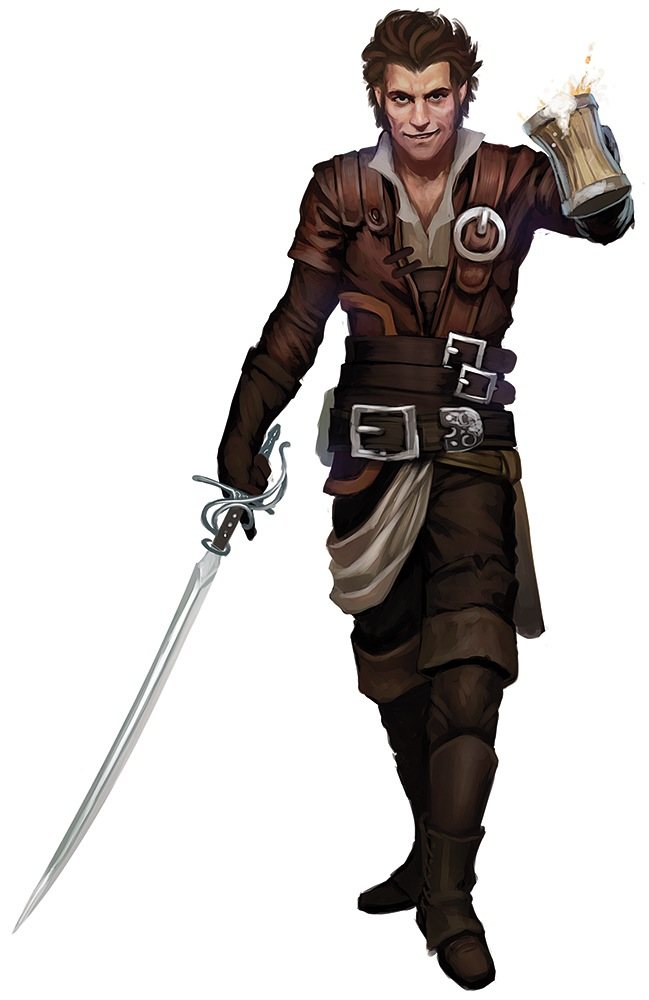
    I’m steadily making spare characters for D&D 5e, partly to help me gain insight into game mechanics while I work on my Musketeers-inspired campaign, but mostly because it’s a fun exercise. I don’t usually do fighters so I thought it was time to give it a try. I’l say this: D&D 5e has finally done a good job making fighters into more than just dumb muscle.

    Here’s his Level 3 character sheet.


    (more…)
  • Marvek, halfling warlock

    Marvek, halfling warlock

    This is Marvek, my second D&D character. (It’s for a one-shot, so don’t worry — Jeribon is still alive and well.) Warlocks are a new class — new to me, at least, as they weren’t in AD&D. They’re an odd type of spellcaster, who has few slots but recharges quickly.

    I have a custom character sheet too. This campaign is starting at 3rd level, which is good, because that’s when warlocks start to get interesting.


    Marvek has always been a bit of an odd halfling. While most seek a life of ease and familiarity, Marvek early on suffered from wanderlust. He sensed that the ordered and tidy lives of halflings stood at odds with the world – not that life is chaos but that life dances to different rules. He felt within him a calling to wander, to see the world, to seek out its hidden regularities; when he reached 14 years, he shook off the dust of his home and took to the road, joining a trading caravan whose captain took a shine to him. Always, he felt drawn westward, eventually to the edge of the great sea, and beyond. At 16, he joined the crew of the Duskwind, a seafaring vessel, and learned the sailor’s trade. His small size and great agility made him a natural in the ropes and rigging, but his interest lay in the steering of the course.

    After a few years aboard the Duskwind, he convinced the ship’s navigator to tutor him in the ways of navigation and sea-pathfinding. He apprenticed for seven years, dividing his effort between his regular sailing duties and the demands of the navigator, a stout human named Sinder. After taking a wound during a run-in with pirates, Sinder developed a raging infection and died, leaving Marvek the role of navigator. Marvek still felt the tidal pull of the west, and when the captain of the Duskwind proposed seeking a legendary lost land where the sun sets, Marvek eagerly supported the plan and promised he could steer the ship there and bring them all home. He proved to be half right.

    The Duskwind set sail for the mythical west, soon leaving behind all known ports of call. Passing through increasingly agitated seas under skies lit by strange purple fire, the ship encountered stranger and stranger creatures and unnatural tides. Within a few weeks of this, the crew wished to abandon the project but Captain Sparshank held true to his purpose, his eyes taking on a mad intensity as he studied the rare and ominous tomes and maps he had accumulated. Only Marvek matched him in enthusiasm, hearing for the first time the dissonant chords that had haunted him finally drifting into harmony. He felt sure that, if they held their course only a little longer, he would finally understand.

    On the seventy-seventh day, the crew had had enough. With supplies running low and no sight of land for weeks, they rose up to challenge the captain. Marvek alone stood by his side. While Sparshank kept the crew at bay with blade and bellows, Marvek kept the ship sailing directly into the sunset. Just as the crew rushed the captain, the setting sun blazed purple and baleful, flaring in ever-increasing brilliance just as the notes haunting Marvek reached an aching crescendo. As he felt his grasp on reality fail, just before his consciousness dissolved in the purple glare, Marvek thought he saw the Sun turn into a giant lidless eye…

    He awoke, dazed and alone, an indeterminate time later on a beach on the western coast of the Iron Confederacy. Through his veins pulsed power he had never known. Behind his eyes danced lines of force and unity. Looking out at the natural world, he sensed that things seem wrong, off, not in accord. Straight lines seem slightly bent; harmonious chords sound vaguely discordant. Rather than curing his earlier sense of dissonance, his experience sharpened it, levering even wider the chasm he felt between himself and others. He knows that out there on the endless sea, something touched his mind and soul, but he does not know what. He has a dim awareness of it in the recesses of his mind but he comprehends none of its purpose or intent. He does sense, though, that his way no longer lies west; he has been cast back to explore the world of mortals.

    It has been nearly two years since his new beginning. In that time, he hasn’t heard even the faintest whisper of the Duskwind or its crew at the time of the event. There are crewmembers who knew him from before, who had left the ship before the fateful voyage. He is unresponsive to their questions and they offer no insight to him. Once, in Ironkeep, across a crowded market, he glimpsed Sparshank ducking into a nondescript inn; but when he worked his way there and investigated, he did not find his former captain. Sometimes he doubts whether he actually saw Sparshank, or whether it was a delusion or a haunting.

    Marvek’s experience has left him feeling even more distant and removed from the world of mortals. He maintains a wall between him and any companions; he does not seek to know their inner lives nor volunteer any of his own. He is generally humorless, although he sometimes finds amusement in things others would not see as such. He bears no particular malice or animus towards others but he also doesn’t exert himself overly on their behalf. On some days, he thinks he moves through a world of illusion.

  • It must be tough being a film critic

    and always having to say something supposedly original and hopefully contrary. The thesis of this article in Deadspin is that Avengers Endgame suffers because it dives headfirst into the mythology and doesn’t pause or slow down for any non-fans watching. I’m just gonna say it: That’s just dumb.

    (No spoilers for Endgame — it’s safe to keep reading.)

    “The Mount Doom scene is well-staged but really makes no sense to someone who hasn’t watched the previous movies.”

    “The Battle of Camlann is satisfying thematically, but what if you aren’t a full-blown fan of Arthurian legend? Why didn’t Mallory write for the people who’ve skipped the backstory?”

    Any franchise risks becoming insular and unaccessible. Continuity can get tangled and collapse under its own weight. But come on. Some things are meant to pay off earlier work. Endgame is not a stand-alone film and makes not pretension to be one. Neither does any of its marketing. It’s not for people who’ve skipped the previous movies, and that’s OK. I follow Ebert’s philosophy: Judge a movie on whether it succeeds at what it sets out to be. Anything else is self-serving navel-gazing.

  • Jeribon

    Jeribon

    Update 2019 May 8: Here’s Jeribon’s 3rd-level character sheet.


    I’m getting back into D&D, hopefully, and I’m starting with Jeribon, a gnomish rogue. In the best traditions of the Internet, I’ve just stolen this image (from http://wow.blizzgame.ru/gallery/hazlow-mudshuggle-by-matt-cavotta/ ) until I can figure out one for myself.

    Backstory

    Jeribon was a young gnome at the time of the Sundering (ten or so years old).  His earliest memories are of escaping the chaos and destruction by fleeing westward.  He has vague, nostalgia-tinted memories of bona fide gnomish communities, rather than the scattered and diffuse enclaves that exist now.  A lot of his memories are sepia and warm and, he knows, probably idealized.

    Jeribon was the youngest of three children.  The middle child Amya (aged 35, or “teenaged” for gnomes) did not survive the passage to the west; her absence is a chasm between Jeribon and his oldest sibling, and was a millstone for his parents while they lived.  The eldest, Bero, had just attained gnomish adulthood (40 years) and had been about to embark on his own independent life when the Sundering hit.  Jeribon’s parents were middle-aged (about 150) at the time.

    After some time wandering as tinkers through the west, Jeribon’s family ended up in Ironkeep, joining the small gnomish enclave there and offering their tinkering and inventing skills to the diverse population.  Jeribon’s mother eventually secured a place with a minor noble and the family settled on the noble’s land a short distance from Ironkeep.  On reaching maturity (40 years or so old), Jeribon undertook the usual gnomish rumspinga, flitting from enclave to enclave to learn gnomish culture in the diaspora.  During this time he picked up his scar and lost his earlobe, but he doesn’t talk about it.

    A couple of years later he returned to the noble’s estate and settled in as part-time tinker and part-time archivist.  He and the noble shared a minor obsession with the written or printed word, and both enjoyed amassing a store of “wisdom” both obscure and trivial.  Bero, feeling constrained, eventually went off on adventures and he lost track of him.  Both Jeribon’s parents passed away a half-century or so after the Sundering – somewhat sooner than the usual gnomish lifespan.  Though they had found peace and a semblance of joy in the diaspora, the loss of the gnomish homelands had diminished their spirits and they simply didn’t hold onto life with as much gusto.

    Jeribon remained at the estate through several more generations.  He spent most of his time squirreled away in the family’s library (ever-increasing, if at a slow rate), serving as archivist, librarian, and sometimes-tutor.  Quick to dispense what knowledge he has (whether you asked for it or not), Jeribon was generally regarded more with amusement than respect, but since his role as tutor was informal and backed by no actual power, he was remembered fondly by the various scions of the noble family.

    Alas for them, the family fortune declined with time.  Almost imperceptibly, the noble line found itself shunted aside as the Iron Confederacy stabilized, recovered, and expanded.  Their rough-hewn ideals fit less naturally into a maturing polity.  Eventually, the line dwindled to a single female heir.  When her parents died, she was foisted off on a fosterage and the lands confiscated by ruthless, but entirely legal, means.  Jeribon found himself on the streets.  He had enough means to live comfortably, but his beloved library (which, after all, wasn’t actually his) was broken up and sold piecemeal.

    Unimpressed by the niceties of the legalistic maneuvering, Jeribon made off with his two favorite volumes – one, a history of the kingdoms before the Sundering and the other, a compilation of swashbuckling fairy tales.  Although he probably could have found a comfortable similar posting, he found himself repelled by the thought of settling back into a nice conventional life.  He’s seen the powerful make the rules to their favor and break them without a moment’s hesitation, and he’s decided he’s going to be a free agent from now on.  And if along the way, he can liberate some of the ill-gotten gain from the powerful and shameless, that’s all to the better.

  • The Orville v. Discovery: Small reference Pools

    I was watching a YouTube video comparing The Orville to Star Trek: Discovery. As it went on, it became almost surreal. At first, it was fine. The YouTuber likes The Orville over ST:D, because it feels more like “classic Trek” — which is a reasonable opinion, and one I more or less agree with.

    But when the YouTuber turns to Discovery, it all goes off the rails. First, he’s upset that the show has Michelle Yoeh, whom he assumes was cast to make the show more marketable in China(?). Then he gets worked up because this China-sellout allegedly continues when the captain quotes “classical Chinese texts that now even aliens seem to recognize quotes from”. Oh noes! Creeping Sino capitulation in Hollywood! What obscure Chinese text does ST:D use, to force on us its China-loving sympathies?

    The Art of War, by Sun Tzu.

    This was the first sign that this yahoo is simply bloviating without having a deep enough reference pool. The Art of War is not really “obscure” and it’s far from unlikely that a Starfleet officer might recognize it. Heck, Fortune 500 company CEOs spout off on The Art of War. This isn’t some Sino-sympathetic debasement; it’s a recognition that the world is bigger than Western Europe. That, it turns out, was my first clue.

    Next, the YouTuber is upset with the redesign of the Klingons. The Klingons in Star Trek have undergone evolution as makeup and budgets improve. From TOS (where they were essentially just human) through the motion pictures to Discovery, they’ve been made progressively less like just humans with rubber bits stuck on. Apparently, the YouTuber dislikes this because it makes it harder for him to imagine human/Klingon sex. Yes, really — that’s his problem.

    He’s also upset that the Klingons speak, well, Klingon. I agree that Discovery might have gone overboard with this in the pilot and first few episodes; there really is a lot of text to read onscreen whenever there are only Klingons present. I think it was an artistic choice, to help make them alien, and I respect it even if I don’t think I’d have made it. Still, this doesn’t really torpedo the show and the YouTuber gets worked up way out of proportion.

    The YouTuber begins to get worked up over the alleged fact that the Klingons in ST:D are modeled on supporters of Donald Trump — a claim he wildly overstates, drawing over-broad conclusions from articles like this one in Rolling Stone. He reassures CBS that they need not worry, because this symbolism went “completely over my head until I read about it online” — a phenomenon, I suspect, is quite common for him.

    Next up, the YouTuber is aghast that Discovery starts with a female captain and a female first officer. Two women at the top of the chain of command? How unthinkable! (He actually calls it “forced”). Of course, if 50% of the population is female and if you’ve reached a point societally that gender is non-determinative for advancement — meaning that there are equal numbers of qualified men and women for jobs like starship captain — then a pair of officers will, on average, have a 25% change of being both female. The ship-based Treks so far are TOS (mm), TNG (mm), ST:V (fm), ST:E (mf), and ST:D (ff). So out of five possible examples of captain/first officer, we have 1 case of female/female. This is only 20%, so Trek is still a bit behind. (Aside: I’m a little tickled that, if you include only “modern” Trek, you get a nice Punnett square. ?).

    It’s important to note that Discovery quickly breaks this anyway, since the actual captain for most of the season is, safely, a white male.

    Why is this even a problem? Well, the YouTuber is quick to point out that most sci fi fans are male. This is actually not clear, since the metrics used generally favor male over female respondents. For a long time, women weren’t welcome as public fans anywhere. His “evidence” is that the metrics of his channel show overwhelmingly male subscribers. But considering his approach, I suspect he simply drives off women viewers.

    An aside: He holds up Captain Janeway as one of the top two Starfleet captains, which by itself disqualifies him as a true Star Trek fan. ?

    YouTube guy is also upset that the main character in Discovery is named Michael but is female. Apparently any time her name is mentioned, it took him out of the episode for 10 seconds or more. It’s fine to have non-human names, even nigh-unpronounceable ones, but don’t dare cross any gender lines!

    YouTube guy is concerned because, even though the captain of the Discovery is a white male, he’s not a clearly-heroic exemplar of Starfleet virtue. He’s not, as Youtube Guy bemoans, a “positive male role model for us guys”. The Orville has a strong male role model and strong female characters, too, he says — but here, it’s clear he simply means strong as in muscular strength.

    Overall, this video was both disappointing and mildly disturbing. It’s particularly annoying because I happen to agree with the ultimate conclusion, that The Orville feels closer to classic Trek than Discovery. But how it gets there and why he feels that way, seem way off to me. I find myself agreeing with someone I don’t want agreeing with me.

  • Movies 2019

    Movies 2019

    • Aquaman (12/27/2018)
    • Bumblebee (1/3/2019)
    • Teen Titans Go! To The Movies (2/16/2019, Google Play)
    • Captain America: The First Avenger (3/15/2019, rewatch, amazon rental)
    • Captain America: The Winter Soldier (3/16/2019, rewatch, amazon rental)
    • Captain America: Civil War (3/17/2019, rewatch, amazon)
    • Spider-man: Into the Spider-verse (3/20/2019, amazon rental)
    • Captain Marvel (3/21/2019, AMC Southroads)
    • Little (4/22/2019, B&B Starworld)
    • Avengers Endgame (4/29/3019, B&B Starworld)
    • SHAZAM! (5/17/2019, B&B Starworld)
    • Men in Black International (6/23/2019, B&B Starworld)
    • Star Wars: The Rise of Skywalker (12/28/2019, B&B Starworld)
  • Books 2019

    Books 2019

    A Song for Arbonne by Guy Gavriel Kay

    This was a re-read for me, as it just became available on Kindle.  It in fact wrapped up my complete re-read of Kay’s fiction, which I mostly handled in 2018.


    Grant by Ron Chernow

    After reading the award-winning (and musical-inspiring) Hamilton by Chernow, I was moved to pick this one up — especially after a positive review by the Grant-fanatic in my life.  I’ve only read through the start of his presidency, but Chernow delivers the same unaffected but impactful style and brings his subject to life.  Incidentally, there are a lot of books about the Civil War; they often neglect the western campaigns. This book covers the War, of course but its subject requires Chernow to pay attention to that part.


    The Prophecy Con by Patrick Weekes

    Book 2 of the Rogues Of The Republic, a follow-up to The Palace Job

    The Paladin Caper by Patrick Weekes

    Book 3 of the Rogues of the Republic.

    Taken together, these three books are a decent if low-impact fantasy series. Intentionally or not, they have a real Leverage vibe (especially the third one), although they’re not quite as polished as John Roger’s classic TV show. Con jobs in fantasy settings are becoming more common (The Lies of Loch Lamora, the Mistborn series) but they all seem to veer into straight up combat at some point. Weekes does a decent job moving the plot along and the (huge) team of players is well-constructed, with everyone getting sharply-drawn personalities.


    The Three Body Problem by Cixin Liu

    The Three Musketeers by Alexander Dumas pere

    Solaris Rising Vol. 2 anthology

    Tales of the Dying Earth by Jack Vance

    A People’s Future of the United States anthology

    Ancillary Justice by Anne Leckie

    A Brightness Long Ago by Guy Gavriel Kay

    Raymond Chandler’s Phillip Marlowe ed. by Robert B. Parker

    The Paper Menagerie and Other Stories by Ken Liu

    Thrawn by Timothy Zahn

    The Raven Tower by Anne Leckie

    Exhalation: Stories by Ted Chiang

    John Quincy Adams: Militant Spirit by James Traub

    An excellent biography of the 6th President, whose term in the Oval Office was in fact one of his lesser accomplishments in the fields of diplomacy and public service.

    James Madison

    The Clockwork Dynasty

    Neverwhere

    The Collapsing Empire

    The Consuming Fire

    A Wizard of Earth-Sea

    Fall, or Dodge in Hell

    The Collected Works of Arthur C. Clarke

    The Map of Knowledge

    Nevernight

    Everless

    The Fifth Season

  • America is a Choice

    It’s been two years since I woke up to a country I didn’t recognize, and I’ve spent a lot of time wrestling with what that means.  I suspect that won’t be ending any time soon.

    Over the course of this administration, my social media feeds have been peppered with reactions to outrages that were virtually unimaginable (in my bubble) before — an accelerating dash toward authoritarian or even dystopian policies and attitudes: Endorsing political violence.  Calling for imprisonment without trial or even evidence.  Designating a free press “the enemy of the people”.  Caging children.  

    (more…)