Blog

  • Lunacon 2014 (1a): Building Character

    Lunacon 2014 (1a): Building Character

    Panelists: Mike Flynn and Ken Atlabef.

    I was a little disappointed to see that the first panel sported Mike Flynn as a guest.  At the last Lunacon, Mike Flynn was the moderator for the panels I consistently liked least.  My recollection was that he was a know-it-all who made points only to emphasize his intelligence or to plug his own books, and that the expertise he claimed did not jive with my own knowledge in those areas I had actual expertise in.  To be fair, at this panel, he was much more witty and, since it was a writing panel, a lot more effective.  He did continue to make it all about him, although it turns out, he can be pretty funny.

    The first thing I noticed is how old the audience skewed — I might have been the second or third youngest person there, and I am no spring chicken.  This might owe to it being the very first panel to open (before they’ve even set up registration!); maybe only geezers can get away in the mid afternoon on a Friday.  🙂  However, looking over the whole evening, it does seem that Lunacon is trending gray.  More on that later.

    The title of the panel was a play on words.  Rather than moral education, it was about how to craft characters that people will care about and that have the strength to carry your story.

    The two panelists did make some really good observations, which I think I’ll find useful when I ever wander back into writing fiction.  In no particular order of importance:

    • Most sci fi is  plot-driven.  Other than sci fi, most modern fiction is character-driven.  This is probably why sci fi fans complain that other works drag or seem to be about nothing.
    • It’s important that characters be true to life.  “True” here doesn’t mean factual or literal.  True-to-life means that the characters act in ways that make sense to the reader.
    • The star of Lord of the Rings is Middle Earth itself.  Tolkein didn’t write a story so much as a travelog.
    • Altabef felt very strongly that you need to “profile” your characters fully before writing them.  He came back to this several times.
      • They need to have a back story and you need to know it.
      • You must create as much detail as you can.
      • But you should reveal only the “telling details” — the ones needed to move the plot or to define the character.
      • It’s OK to surprise the reader later but you should never be surprised.
      • That’s what a first draft is for — to uncover the ways your characters will surprise you.
    • Flynn felt that, when you introduce a character, you should provide the reader with a physical image as soon as possible with as much definition as possible.
      • Don’t write stories about ghosts (unless it is a literal ghost story and your character is  a literal ghost).
      • The character should be doing something that reveals who he is.  Think Indiana Jones, who is being Indiana Jones — whip cracking, cautious, observant — within 30 seconds of appearing.
    • Dialog is the way you reveal and explore your characters.
      • Every character should sound like  a person.  They should not sound like the same person.  🙂  A note for Aaron Sorkin, I suppose.
      • You can flesh out dialog (and break its monotony) with eye movement, facial expression, tone of voice.
      • A good writer is observing people all the time and noting their distinguishing tics, mannerisms, etc.  You should constantly observe people to try to figure out their motivations — getting them “correct” is less important than the exercise of coming up with them.
      • There’s a writing exercise that occurred to me that I want to try: Come up with a situation or piece of conversation and re-tell it for each character.
    • Character flaws are useful hooks.
      • It’s best if the character’s flaw has something to do with the actual story.  🙂
      • It’s imperative to avoid Mary Sue syndrome.
      • One technique: Assign each character their Myers-Briggs score, then put them in a situation where they have to act against it.  Use that discomfort.
    • Villains
      • No man is a villain in his own eyes.
      • When possible, include an anti-flaw — a redeeming quality — to avoid the Punch Clock Villain problem.  Unless that’s what you’re going for, which is OK in its own right.
      • Generally, don’t have the villain do it for the evulz.
      • A truly great villain leaves the reader unsettled, because he/she demands sympathy or at least understanding.

    Then the group degenerated into discussing Batman.  Of course.


  • Lunacon 2014 (0): Arrival

    Lunacon 2014 (0): Arrival

    After a five-year hiatus, I am back at Lunacon, at the suggestion of my lovely wife (who says it’s important we tend to our individual needs as well as our married ones, and who — I believe — also might like having the apartment to herself for a weekend. 🙂 )

    Standing in line to check in, I met a guy for whom this is his 43rd Lunacon.  It’s my fourth.  I feel a bit like a poser, but oh well.  🙂

    Before heading down to register, I figured I’d check into the room, set up Internet (of course!), and then start these posts.  I can’t promise much, but I figure that, if the reason I attend Lunacon as opposed to other cons is its traditional focus on writing, I should also do me some writing.  Maybe it will be something more, but blog posting is probably a good way to start.


  • Marc Cohn and guests at the City Winery : 2013 Feb 14

    I’ve sort of blown the deadline on my 30 Days of Marc Cohn, but I can at least offer up this playlist. 🙂

    1. “From the Station”
    2. “Ghost Train”
    3. “Perfect Love”
    4. “The Letter” with Jon Leventhal
    5. “29 Ways”
    6. “Listening to Levon” with Dave Mansfield
    7. “Healing Hands” with Rebecca Pidgeon
    8. “Witness” with Rebecca Pidgeon
    9. “Silver Thunderbird”
    10. “Walking in Memphis”
    11. “Only Living Boy in New York”
    12. “Into the Mystic”
    13. “True Companion”
    14. “The Things We’ve Handed Down”
    15. “One Safe Place”
  • Art and Design, Fail

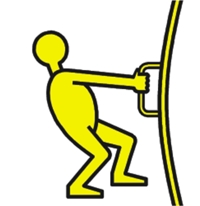
    I’ve been doing a little reading on the art of design and the failure of art as design.  (For example, see this piece about how objects for human use should be designed for, you know, humans.)  That led me to the International Push/Pull Pictogram Design Competition, tasked with designing exactly what it says: a non-verbal universal symbol to indicate which way to move a door to open it.  Some of them are awfully inspired and some of them are just awful.  But the “winner”, I feel, simply replicates the problem:

    A pictogram of a yellow man pushing.A pictogram of a yellow man pushing.

    Quick: Which of these says “This door opens by pulling”?

    I would argue that you can make a case for either one.  The person on the right is clearly pulling, so maybe that means “Pull this door”.  But the door is bulging outward — which says, to me, that the door is not cooperating — it isn’t opening — and so you shouldn’t pull, you should push.  (Likewise, the person on the left is clearly pushing but the door isn’t opening; maybe pushing isn’t the right choice.)

    The judges picking the winning logo gave the following explanation (in part):

    The push symbol is as if the figure is pushing a car and the pull symbol is a figure pulling as if in a tug of war. For extra clarity and to give the impression of force and movement, the doors being pushed and pulled are bowed-shaped.

    But in so doing, they fell prey to the same problem they thought they were solving:  The pictogram needs to be explained, so it is neither universal nor obvious.

    Personally, my choice would have been the one to the right of the upper-left corner of the submissions:

    pushpull

    This is unambiguous as to how the door moves.  It also serves as a nice warning that the door opens outward, in the second case.  (There was a similar one with hands but I think that is too specific:  The door opens inward whether you pull it or someone pushes on the other side.)

  • Review: The Hunger Games (2012)

    I suspect I’m about to draw down the wrath of the Internet on me, but I finally saw The Hunger Games (the first one) and I’m simply not impressed.

    Spoilers and such.

  • Review: The Day of the Doctor

    So Doctor Who has been bopping around time, space, and the BBC for 50 years now, and the Beeb put on a very special 50th anniversary episode.  My thoughts below.  And, to quote a certain archeologist: SPOILERS

    (more…)

  • Miracles and Wonder

    Miracles and Wonder

    2013-08-14 15.04.38 I just received the Kingston 64 GB USB flash drive shown above.  It holds (duh) 64 gigabytes of data.  I’ve included a US quarter for size comparisons. My first computer was a Commodore-64, for which I had the venerable C1541 floppy disk drive. That used 5.25″ floppy disks — which were actually floppy, you could bend them (though that was not advised!) — and could cram as much as 165 kB onto each one. Yes, that’s kilobytes. This means that, to hold the same amount as the flash drive, I would need something like 406,721 floppy disks. Laid end-to-end, they would stretch about 33 miles, or half again as long as you’d need to bridge the English Channel. Laid out in a square, they would cover an area of about 1.8 acres or 1.44 (American) football fields. Stacked, they would stand 650 m tall, or about 1.46 Empire State Buildings. A single floppy disk cost about $2.25 (when purchased in bulk, and we would obviously have to do that!). So the cost to own this much storage would be about $915,120. We probably shouldn’t neglect you’d have to buy the drive as well — that would add $400. OK, we probably could neglect that.  Oh, wait. That was in 1982. According to the Inflation Calculator, $915,520 in 1982 would be equivalent, more or less, to $2,144,035 in 2012. (Information not available for this year yet.) I paid amazon.com the princely sum of $37. And got free shipping. (And don’t need a warehouse to store my 400,000 disks!) My point? We live in an age that would leave Scheherazade a-gasp and disbelieving. We live in an age of miracles.

    Also, get off my lawn.

  • The buzz about the loop

    So Elon Musk has revealed his great new intercity transit idea, the HyperLoop.    It would seem the emphasis should be on the first syllable — to wit, HYPE — but I’ll leave engineering analyses to those far more qualified than I.  My impression is that Musk offers vaporware that over-promises and under-delivers, that will never be implemented and would fail if it were.  (See here for one take-down.)  I’m more interested in how he generated all this buzz and why the media fell all over itself to hype it.

    A good starting point is simply that it’s August and the news is slow.  There haven’t been any recurrences of the 2010 summer of rage to capture the media’s attention.  So a guy who’s always been good at self-promotion and who has a flair for the cool can definitely garner a few minutes air time.  But I think there’s more.

    First, as a society, we fetishize monetary success and idolatrize those who achieve it.  We assume that anyone who’s made a bunch of money must be intrinsically smart, clever, or wise, and that this means he — and it is almost always a “he” — will magically have expertise in areas far removed from the one in which he made his fortune.  (Not to double-link, but this point really is made nicely at the article above.)  This impulse is particularly virulent in an age when the captains of industry must desperately justify their outsized share of the economy to the plebes whom they stand upon, and since media empires are one of the trappings of those captains, the popular media go along.  We must worship success and idolatrize financial achievers, because otherwise the grueling inequality of our system would make us monsters.

    Second, and not unrelated, we live in an age that builds up the private enterprise but denigrates the public work.  An entrepreneur is to be hailed and held up; a privately-funded superssytem is admirable.  But a public/private partnership that slogs through all the legwork of providing a high-speed rail system?  That must be torn down.  It is considered prima facie susceptible to corruption, of course, but it’s even worse if it succeeds.  A successful HSR project would not only pump money into the economy; it would be evidence that government can succeed, and our current political atmosphere cannot sustain that sort of heresy.  (There are definite shades of Atlas Shrugged here, which probably also help explain the positive reception of a subset of the media.)

    Third, the HyperLoop idea plays into a creeping anti-professionalism in American culture.  We are more and more convinced that “expertise” doesn’t exist.  Anyone with a big idea can succeed!  Details are for wimps!  This myth comforts those at the top of the pyramid, of course, because it can post facto justify their position and tells them it’s OK to leave the hard work of, say, designing things to others.  (I submit it’s one reason for the idolization of Steve Jobs, whom many have distorted into just an idea guy.  I don’t think Jobs himself fell victim to this; he insisted on solid work and good design.)  The Big Idea myth, ironically, also comforts those not at the top.  They can imagine that, someday, their own Big Idea will come and they will catapult into the stratosphere of the 1%.  They don’t have to work, or save, or plan; they just have to wait for inspiration.  (A twisted version of this is peddled to our youth, who see their way out of the morass in athletic or musical stardom — and again, the assumption is that talent trumps training.)

    Finally, and not unrelatedly at all, the HyperLoop ties into the strain of romanticism that infest American pop culture.  We celebrate the dashing hero, the incorruptible outsider, the lone genius.  Our central myth is the rugged individualist.  Of course, our understanding of how the West was won is little more than myth.  Consistent and continual community-building made this country, not loners standing in wastelands.  Our films reinforce this, even in our science fiction, with The Professor the common archetype for the “good” scientist (and the evil genius his dark counterpart):  A man (and again, it’s almost always a man) who stands outside the scientific consensus, sees things no one else can imagine, and single-handedly fashions exotic new technologies and whole worlds from the fruits of his solitary mind.  This is the exact opposite of science, of course, with its community of learners and its painstaking assembly of new knowledge from the pieces contributed by hundreds of peers.  But The Hero is sexier than the team, and so we celebrate that.  We find irresistible the idea that the one guy — a genius or a billionaire — could sweep past the hundreds of researchers, activists, and experts patiently slogging away.  (Any consideration of this fight would be remiss without pointing toward David Brin’s brilliant analysis of Star Wars versus Star Trek and what each says about our values.)

    We live in a complex and scary world, with intimidating and complicated problems.  It’s a dangerous conceit to believe that there are simple and clear answers that, somehow, no one’s thought of.  It happens from time to time, of course, but so do lightning strikes.  The human mind amplifies the impact of rare events and accords them a too-great weight in how we plan things.  The solution to high-speed intercity transit is unlikely to come out of the blue from a guy who’d hardly thought about the problem before.

    Some people have made dark rumblings that Musk —  a man who’s trying to sell cars and thus has a motive to sabotage trains — might just be committing an underhanded intellectual fraud in pursuit of profit.  I don’t think that’s true.  I think he’s deluded by his impression of his own genius, and his delusions neatly plug into our societal ones.

  • The Name of the Doctor

    So, that’s a bit of a tease, isn’t it?  Lots to think about in the season 7 finale of Doctor Who, but first, as River might say, Spoilers!  (There’s a recap available at tv.com.)

    ==============================================

    (more…)

  • This is important: What we know about what happened in Boston

    Nothing.

    We know nothing of import yet, and won’t for several hours, if not an entire day. That is the way of these things, and the truth of them.

    Nonetheless, the circus has begun. Each network has already offered its own (or its several own) opinions on who caused the bombing, who planted the bombs, and why. They’ve thrown up experts onto the screen, some with actual expertise but none with actual knowledge. How do I know? Because anyone who does actually know something is busy right now, with, you know, the investigating and the saving lives and stuff.  People who know are too busy contributing for them to waste time satisfying our ghoulish need for details.

    The terror of actions like this, for me, does not lie in the risks we face or the suddenly-heightened sense of my own mortality.  The terror lies in the amazing speed with which this sort of event divides us, inflames us, sets us against each other.  It did not take long for World Net Daily to come up with its list of suspect ideologies to be blamed.  It didn’t take long for CNN.  It didn’t take long for me — and that’s what scares me.  I have to keep reminding myself that we don’t know anything.  We don’t know if this is the work of a terrorist group (foreign or domestic), or a lone madman, or someone with a grudge or a defective sense of grandeur or an aching consuming need to grab our attention.

    It is so easy to take such an event and slot it into our comfortable pre-existing narratives. We spend our time imagining the worst of our opponents, so when the awful happens, we say “I can see how [group X] might be behind this sort of thing”, and then we seamlessly convince ourselves that they are behind it, and eventually we forget that we’re just speculating.

    There is a nebulous, magical radius around the site of a catastrophe.  Within that distance, we find the extraordinary ordinary people, the ones who run into fire and smoke and fear, who reach across the yawning divide and yank people back, the ones who won’t give up and won’t let go and who unthinkingly do the right thing.  But beyond that special radius, it seems we fall prey to the worse angels of our nature: We accuse and tar and disdain; we assume the worst; we fall upon each other in anger and accusation.

    So, tonight, let us remember this:  We don’t know anything yet.  The who and the how and the why will come out, will be known, will be important, but not tonight.  We don’t know anything tonight.  How this happened and how it could have been avoided and how it might happen again — these are questions of weight, but not right now.  We don’t know anything — except that some have died, many are injured, and many more are grieving.

    Tonight, that is our truth.

    [Note: This post has been edited for spelling and grammar.]