I actually agree with most of what Fareed Zakaria writes in his Washington Post op-ed “Why America’s Obsession with STEM Education is Dangerous“. We need balanced, robust, well-rounded education, not narrow business-driven training. It will take many different vantages points to see solutions to the problems we face in this hardest century of human history. Students of mine often express shock (and perhaps a little betrayal) when they complain about, say, their history teacher and ask me “Don’t you think it’s just a waste of time?” only for me to reply that it is one of my favorite subjects. As a physics guy, I obviously think we need more and better science teaching, but I also think we need more and better teaching in the humanities and the arts.
Having said that… boy, does this one sentence put me in a slow burn:
No matter how strong your math and science skills are, you still need to know how to learn, think and even write.
It angers me that Farakaria, with a vast platform, falls into the stereotypical thinking that these skills — learning, writing, thinking — are somehow not part of the math/science pool. In actuality, of course, scientists, engineers, and coders practice those skills constantly. While there are surely scientists who cannot write, there are English majors with the same problem. STEM thinking isn’t the only kind of thinking we need, but it is thinking. It is both disingenuous and insulting for him to imply otherwise.
I know it’s a small piece of a larger argument, but it still rankled me.
Today the NY Times published an Upshot op-ed called “For Accomplished Students, Reaching a Good College Isn’t as Hard as It Seems“. It’s one of those article that seems to say more than it does. It doesn’t actually support the conclusion it asserts. Saying that roughly the same percentage of “top students” still get admission to elite schools is almost self-evidently circular, and does nothing to dispute the notion that “college admissions has become a Hunger Games-like tournament”. In the Hunger Games, the same number of winners happened each year — but the competition wasn’t always the same. And what constitutes a “top student” could (and does!) vary from year to year without creating more of them.
I am far from the first to ask this question in an increasingly-electronic age, and I am sure that my answer will be far from unique. But my wife and I have batted the question around a couple of times and I wanted to get my thoughts down. The proximate cause of our discussion was an meditation on the large space allocated to the library in the school where I teach, the dusty and ill-utilized books moldering there, and the concern that the library might come to be seen as “wasted” space. The thought of a college-prep school without a library seems equal parts worrisome and absurd, yet it’s hard to argue in favor of the proposition that the stacks continue to serve their traditional vital role in education. Can the library be saved when books have fallen out of favor?
It’s easy to blame hidebound educators for educational malaise, and some of the blame lands justly. But you cannot begin to understand the problem until you realize how strenuously parents resist any change that means their kids aren’t learning it the way they did. If education “looks different”, it is distrusted and undervalued. (Witness the growing backlash over Common Core.)
Sorry for being so obvious. But I’ve read his latest ill-informed anti-immigrant screed and couldn’t stay quiet.
Buchanan’s thesis is that we were once a unified country but now since 1960, we’ve been in decline. First off, it’s a little suspicious that the magic time was exactly when Pat Buchanan (born in 1938) had just reached majority age. Nearly everyone looks back on their twenties as the halcyon days. It’s the moment you first achieve independence from your parents, when you come into your own agency, and when you (most likely) start paying attention to the world around you as if you were a part of you. That is, how the world is becomes your frame of reference for how the world should be. But really that’s just the drug of nostalgia, and it’s no different than Homer Simpson declaring that “rock attained perfection in 1974 — it’s a scientific fact”
.
Buchanan then pivots to alerting us to the existential threat to America poised by unaccompanied children fleeing violence. He of course invokes sainted Ronald Reagan of blessed memory: “For, as Ronald Reagan said, a nation that cannot control its borders isn’t really a nation anymore.” I’m not exactly sure how he squares that with the open borders of the Roman Empire, or the British one, or indeed, most of US history. But whatever.
Buchanan also invokes the Federalist papers and John Jay’s comment that “Providence has been pleased to give this one connected country to one united people – a people descended from the same ancestors, speaking the same language, professing the same religion, attached to the same principles of government, very similar in their manners and customs. … ” This might have made good propaganda, but I’m fairly sure that Jay’s words would have irked the already-numerous German, Scottish, Irish, Danish immigrants who had fought in the Revolutionary War to help establish this nation.
Buchanan asserts “We were not a nation of immigrants in 1789″, which is just laughable. Heck, Andrew Hamilton — another of the authors of the Federalist Papers — was an immigrant to these shores. While many of the colonists were born in America, many had travelled here. And above all of that, you might want to ask a Native American, who might remind you that all the White guys were immigrants or recent descendants of immigrants.
Buchanan also says “The republic of the founders for whom Jay spoke did not give a fig for diversity. They cherished our unity, commonality and sameness of ancestry, culture, faith and traditions.” This certainly makes one wonder about the long, drawn-out, sometimes-vicious fights in the Continental Congress between (usually) the New England and the Deep South contingents. Oh, also all that time and effort spent trying to square the circle on the South’s “peculiar institution”.
This brings up the largest hole in Buchanan’s argument. We used to be all one happy, unified, uniform family? What drugs is he on? Look at the treatment of any minority population in the US (and, hey, we do actually have some and always had): the Native Americans, the Blacks, the Chinese. Heck, look at how the Irish were treated. It’s a little hard to swallow that we were a unified culture. Instead, we had the in-power culture (more or less the WASPs), who then simply declared that other cultures were backward, uncivilized, and plain old irrelevant. Buchanan’s reasoning boils down to “There was only one culture — as long as you ignore all the other ones.”
It is nice that Buchanan admits, obliquely, that maybe not everything was rainbows and unicorns: “And though the civil rights movement had just begun, nowhere did black peoples enjoy the freedom and prosperity of African-Americans.” That’s right, in the magic year of 1960, White culture finally started to grudgingly offer some semblance of fairness to the Black population, a mere century after the bloodiest war in American history and the abolition of outright slavery.
Quibbling with Attorney General Eric Holder’s assertion that America is “a fundamentally better place than we were 50 years ago,” Buchanan laments that nonetheless “We are no longer one unique people ‘descended from the same ancestors, speaking the same language, professing the same religion’.” But the fact of the matter is, we never were. You can only pretend that we were by ignoring the reality, twisting the history, and unlearning the lessons. You can only pretend we were when you define “real America” as “exactly and only the small patch of ground I grew up on”.
As evidence of how far we’ve fallen, Buchanan lists a bunch of things:
We are from every continent and country. Nearly 4 in 10 Americans trace their ancestry to Asia, Africa and Latin America. We are a multiracial, multilingual, multicultural society in a world where countless countries are being torn apart over race, religion and roots.
We no longer speak the same language, worship the same God, honor the same heroes or share the same holidays.
But he says these like they’re bad things, whereas I think they speak to the enduring strength of this nation, to adapt, persevere, and improve itself — to strive always to become a “more perfect Union”. For someone who sings of “American exceptionalism”, Buchanan misses what makes us exceptional: Not the fortuitous vast natural resources, or the particular spot of earth on which we stand, or the world’s oldest free trade zone or the world’s oldest constitutional republic, not a fictitious single language or single culture. We are a nation of peoples, a weird and wonderful dream bringing together cultures, and languages, and experiences, and hopes and aspirations from all that humanity has to offer. America the nation is an idea, not a place or a people. And that is largely unprecedented and ambitious.
A final comment: One of the things that so disturbs Buchanan is that “Stonewall Jackson and Robert E. Lee are out of the pantheon”. And I say, Yea! to this, and good riddance. The triumph of the American spirit is that we can finally reject these traitorous and seditious, fundamentally dishonorable men who abandoned the United States and its Constitution, not to mention their own sworn oaths, in a parochial construction of duty to defend a heinous state founded on the noxious principle that some humans have, as a divine right, the right and even obligation to own other human beings. (If you’re one of the revisionists who want to argue that “the Civil War wasn’t about slavery”, I suggest you read the ordinances of secession, or indeed, the Constitution of the Confederate States. See also an analysis of slavery in the Confederate constitution, or a similar analysis.)
And I mean that non-ironically. I don’t like paying taxes, but I am proud to do it. Taxes are not only necessary to maintain the way of life we value. They are a direct investment in the very concept of civilization. Taxes are the explicit statement that we are a community and we have a communal responsibility to each other. They are also the explicit recognition that no one is in this alone, that no one is solely responsible for his or her own success, and that we are, to some measure, dependent on each other.
Yes, I inveigle against waste and fraud, just like everyone else. Perhaps even more so, because they are a violation of this trust, that the communal burden be fairly borne and communally valuable — that no individual benefit unduly. But the current fetish on minimizing taxes (even at the cost of undermining society) boggles my mind. It reeks of hubris and solipsism.
Taxes are a burden but not all burdens are bad. Jingoists like to lecture us “Freedom isn’t free” — and indeed, it isn’t. Part of the cost — not the lion’s share, but not a negligible one — is directly an economic one: The taxes we pay. You cannot defend a nation, or provide speedy justice, or protect the innocent, for free. You cannot offer hope and opportunity, or discover new cures, or build a better future, for free. The American project, whatever that turns out to be, is bigger than any one person or any one group. Taxes are part of the sinew that binds us into one nation.
Taxes help make clear: We are all in this together.
So again, I say, Happy Tax Day!
(For your amusement, here’s a link to the original income tax forms.)
Panelists: Carole Ann Moleti; Michael F. Flynn, Raymond Feist, Jane Sibley
Interesting tidbit: religion = re+ligio = a rebinding of society (to join again). Religion has always had a social purpose, to increase community and tie society together.
The panelists offered a definition of magic as “a belief that mundane objects have hidden powers”, whereas religion is generally more abstract and removed. For example, if a stick brings forth water when banged against rock, it’s magic. If banging the stick against rock brings forth water because God intervenes, it’s religion. Religious talismans and symbols (and prayers, I guess) work by evoking the higher power, not through themselves. I’m not sure I entirely buy this distinction but it’s worthy of thought.
Cities are often centers of “high” religion whereas villages and rural areas are typically bastions of household religions. You could see this clearly in ancient Greece and Rome, where the myths we learn in school are in fact the high tradition of the citied elite.
It was inordinately fun to watch Raymond Feist shut down Michael Flynn at every turn, casually squashing his gambits and shooting down his points, without even ever seeming to notice he was doing it.
During the panel there were escalating background noises — renovation work down the hall, a panel on electronic synthesizers going on next door — which make the whole thing a little bit like a Muppets sketch.
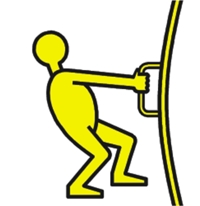
I’ve been doing a little reading on the art of design and the failure of art as design. (For example, see this piece about how objects for human use should be designed for, you know, humans.) That led me to the International Push/Pull Pictogram Design Competition, tasked with designing exactly what it says: a non-verbal universal symbol to indicate which way to move a door to open it. Some of them are awfully inspired and some of them are just awful. But the “winner”, I feel, simply replicates the problem:
Quick: Which of these says “This door opens by pulling”?
I would argue that you can make a case for either one. The person on the right is clearly pulling, so maybe that means “Pull this door”. But the door is bulging outward — which says, to me, that the door is not cooperating — it isn’t opening — and so you shouldn’t pull, you should push. (Likewise, the person on the left is clearly pushing but the door isn’t opening; maybe pushing isn’t the right choice.)
The judges picking the winning logo gave the following explanation (in part):
The push symbol is as if the figure is pushing a car and the pull symbol is a figure pulling as if in a tug of war. For extra clarity and to give the impression of force and movement, the doors being pushed and pulled are bowed-shaped.
But in so doing, they fell prey to the same problem they thought they were solving: The pictogram needs to be explained, so it is neither universal nor obvious.
Personally, my choice would have been the one to the right of the upper-left corner of the submissions:
This is unambiguous as to how the door moves. It also serves as a nice warning that the door opens outward, in the second case. (There was a similar one with hands but I think that is too specific: The door opens inward whether you pull it or someone pushes on the other side.)
We know nothing of import yet, and won’t for several hours, if not an entire day. That is the way of these things, and the truth of them.
Nonetheless, the circus has begun. Each network has already offered its own (or its several own) opinions on who caused the bombing, who planted the bombs, and why. They’ve thrown up experts onto the screen, some with actual expertise but none with actual knowledge. How do I know? Because anyone who does actually know something is busy right now, with, you know, the investigating and the saving lives and stuff. People who know are too busy contributing for them to waste time satisfying our ghoulish need for details.
The terror of actions like this, for me, does not lie in the risks we face or the suddenly-heightened sense of my own mortality. The terror lies in the amazing speed with which this sort of event divides us, inflames us, sets us against each other. It did not take long for World Net Daily to come up with its list of suspect ideologies to be blamed. It didn’t take long for CNN. It didn’t take long for me — and that’s what scares me. I have to keep reminding myself that we don’t know anything. We don’t know if this is the work of a terrorist group (foreign or domestic), or a lone madman, or someone with a grudge or a defective sense of grandeur or an aching consuming need to grab our attention.
It is so easy to take such an event and slot it into our comfortable pre-existing narratives. We spend our time imagining the worst of our opponents, so when the awful happens, we say “I can see how [group X] might be behind this sort of thing”, and then we seamlessly convince ourselves that they are behind it, and eventually we forget that we’re just speculating.
There is a nebulous, magical radius around the site of a catastrophe. Within that distance, we find the extraordinary ordinary people, the ones who run into fire and smoke and fear, who reach across the yawning divide and yank people back, the ones who won’t give up and won’t let go and who unthinkingly do the right thing. But beyond that special radius, it seems we fall prey to the worse angels of our nature: We accuse and tar and disdain; we assume the worst; we fall upon each other in anger and accusation.
So, tonight, let us remember this: We don’t know anything yet. The who and the how and the why will come out, will be known, will be important, but not tonight. We don’t know anything tonight. How this happened and how it could have been avoided and how it might happen again — these are questions of weight, but not right now. We don’t know anything — except that some have died, many are injured, and many more are grieving.
Tonight, that is our truth.
[Note: This post has been edited for spelling and grammar.]
It’s not small-government. It’s not anti-tax screeds or culture war crusades. It’s not being pro-big business or pro-gun. It’s not being anti-choice or anti-gay. It’s not suport of “traditional marriages” or of non-traditional “special interrogation”. It’s not being pro-Gitmo or anti-drone or pro-Keystone or anti-FEMA. It’s not even being sexist or being racist.
It’s a complete and utter lack of empathy, and an unhealthy disdain for the same in others.
How else do you explain the sudden 180? shifts in philosophy once the consequence of the party line hits home? Dick Cheney supports gay rights, because his daughter is a lesbian. Bob Portman now supports same-sex marriage, because his son has come out of the closet. Mark Kirk suddenly understands the value of government health care, once he has a brush with death. It’s how Republican governors can decry federal spending on disaster relief… right up until their state needs it.
Republicans like to claim that they’re the party of grown-ups, reining in those rascally irresponsible Democrats. But a hallmark of maturity is the development of empathy — the ability to think beyond the confines of your personal experiences and to imagine, however imperfectly, the life lived by people who are not you. On that measure, the Republican Party is a haven for toddlers and crybabies. I applaud Senator Portman for revisiting his philosophy in light of new evidence, but if we have to wait for a singular personal experience for each and every Republican, it’s going to be a long long slog.
![By Godot13 (Own work) [CC BY-SA 3.0 (http://creativecommons.org/licenses/by-sa/3.0)], via Wikimedia Commons](http://upload.wikimedia.org/wikipedia/commons/9/93/Gruuthuse_Museum_Tower_%28Bruges%2C_2009%29.jpg)