{Originally penned 2015 Apr 26and recently rescued from the Drafts folder}
So there have been police confrontations (and possibly even riots) in Baltimore over the past 12 hours, but apparently CNN didn’t feel compelled to cover them. Instead they kept with covering the White House Correspondents’ Dinner where various people, including the President, got to make jokes. Justification for ignoring the major story a mere hour’s drive north included:
“You can find a live feed if you actually want to watch what’s going on”
though apparently not on CNN, a 24-hour news network to which people (supposedly) turn for exactly that — live coverage of significant events.
Also offered was this gem:
“People will be informed….They’ll find out all of what happened in the streets of Baltimore by this time tomorrow”
I sort of thought that informing people was exactly the role of — and I repeat myself — a twenty-four hour news network. But hey, maybe I’m old fashioned. And this could easily be spun into a “death of old media” story about how traditional news renders itself irrelevant by ceding the breaking stuff to the Internet., and get off my lawn, and all that. But I want to go a different direction.
This is not just CNN old-media cluelessness. This is a symptom of rot at the core of our democracy. The opinion-shapers and policy-makers of the Republic gathered in that room, and it was shown for all to goggle over. They entertained themselves and rubbed shoulders and celebrated just how accomplished and how connected they are. And they are! All the big names in politics come out and make nice with the so-called journalists tasked with covering them. A big messy live situation? That would ruin the ambience.
The WHCD has become a festering boil, a signal of the decline of American reporting and the rise of what might be called the journalism-industrial complex. All that matters to the powers that be is a navel-gazing exercise of petty partisan politics and vast egoism. While real people march and protest and die, the influence-peddlers of our day can’t be bothered to even note it in passing.
What might underlie this Russian perception — which I think is over the top — is something far more threatening to the Russian psyche than the idea that America is scheming and plotting to topple them. Far worse indeed is the truth, which is that since the end of the Cold War we’ve more or less ignored them. A lot of what Putin has done, seems to me, to be the geopolitical equivalent of a moody tweener screaming for attention from the once-idolized cool kid who nows ignores them. Going from being one of two superpowers, where every time the Kremlin caught a cold, Washington sneezed, to a perceived backwater minor power, is bruising.
Having said that, from one point of view, they’re not entirely crazy. While I think they overestimate the coherence of any “American worldview”, there is a certain evangelizing tendency in American politics. We’ve solved it, many Americans think, and of course everyone else should reap the benefit of our leadership. It’s cloying and positive but threatening in its own way. And the ongoing cultural ascendancy of American media — where our action films and pop fashions rule the world — can’t help anyone feel secure.
It’s hard to see what to do about this. You can’t convince someone you’re on their side by simply repeatedly telling them that. And our actual attitude — dismissive neglect — is unlikely to generate either the evidence of a benign attitude or reciprocal respect. The nigh-complete breakdown of the American political machine implies more neglect and drift, with sporadic and counterproductive engagement mixed with saber-rattling for domestic benefit. It’s a bind.
For everyone who has counseled the citizens of Baltimore (and Ferguson and…) that “violence is not the answer” and that it would be better if everyone just protested peacefully:
1) As has now been documented extensively, the protests were by and large peaceful — and even more by and large, ignored by the national media.
2) Violence certainly is an answer — and one which history shows can be quite effective in prompting change. See for proof the French Revolution, or the American Revolution, for that matter. Of course violence is a random and uncontrolled beast, and the odds are that the reaction it prompts will not be the outcome desired… but usually, something will change. For people who’ve spent their whole lives trapped in a system crushing them without end, any change might be welcome, at least at first.
Would you prefer peaceful protest to violent outbursts? Would you see people advocate for the redress of grievances without resorting to threats or damage to property or even lives? Then address the systemic evils, the in-built hardships and unspoken oppressions, the things done not through active racist thought but through the far worse passive racist without-thought. You want people to respect the police? Then demand that the police behave respectably. You want your cities to be bastions of peace? Then save them from being cauldrons of hopelessness.
Above all, if you want this problem to “just go away”, pay attention to it — and for love of all that is true, pay attention even when the fires have gone out and the windows have been repaired and the next big distraction comes down the tube. This problem has been centuries in the making and we’ve squandered five decades or more in addressing it — it won’t ever go away until we finally put it away.
Apparently the study was so flawed that only a man could fix it.
Just ’cause, you know, it isn’t science without at least a trace amount of testosterone spilled on it.
Or — and this seems more likely to me — the editor is himself hard up for papers with his name on them, and desperately hopes that he’ll be the man they chose for co-author.
Gov. Huckabee is entirely correct: SCOTUS cannot overrule God. The justices can’t make a gay marriage sanctified. But then, they can’t make a straight marriage sanctified either. It’s really quite simple: To the extend that marriage is a sacrament, the government cannot have an opinion, and the marriage-equality suits do not speak to this. To the extent that marriage is a social contract for the transmission of and management of property — i.e., its historical role in society — then the government can regulate and must ensure equality. Anything else is sophistry.
That means I happen to agree with the loons in Oklahoma and elsewhere, though I disavow their motives: Get the state out of marriage entirely. Enact universal civil union laws that any pair of consenting adults may enter into, and leave the sacraments to the churches.
From Talking Points Memo:
Former Arkansas Gov. Mike Huckabee (R), no stranger to mixing religion and politics, might have outdone himself on Wednesday night when he greeted the National Hispanic Christian Leadership Conference.”I do not come to you tonight with the ability to speak Spanish. But I do speak a common language: I speak Jesus,” he said, according to CNN.
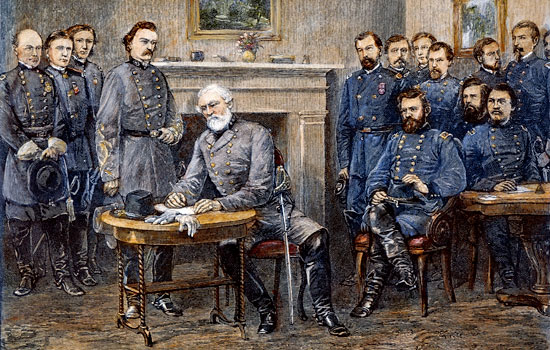
On this day one hundred fifty years ago, a scruffy, scrappy, but determined general accepted the surrender of his well-born, well-dressed, and traitorous counterpart, effectively ending a vast sedition launched in the name of slavery, orchestrated by cowardly politicians, and fought — like most wars are — by poor men dying at the behest of rich men. There was no nobility in the losing side; there was no honor; there was only the proposition that one man might justly hold another as property, and that in support of that one twisted principle, oaths may be broken, loyalty suborned, and a great democracy threatened with sectarian dissolution.
Stragglers of the Confederate army fought on for a few more weeks. Their descendants, stragglers of history, fight on today. Their cause is equally dishonorable, equally seditious, and, thankfully, equally ultimately futile.
I actually agree with most of what Fareed Zakaria writes in his Washington Post op-ed “Why America’s Obsession with STEM Education is Dangerous“. We need balanced, robust, well-rounded education, not narrow business-driven training. It will take many different vantages points to see solutions to the problems we face in this hardest century of human history. Students of mine often express shock (and perhaps a little betrayal) when they complain about, say, their history teacher and ask me “Don’t you think it’s just a waste of time?” only for me to reply that it is one of my favorite subjects. As a physics guy, I obviously think we need more and better science teaching, but I also think we need more and better teaching in the humanities and the arts.
Having said that… boy, does this one sentence put me in a slow burn:
No matter how strong your math and science skills are, you still need to know how to learn, think and even write.
It angers me that Farakaria, with a vast platform, falls into the stereotypical thinking that these skills — learning, writing, thinking — are somehow not part of the math/science pool. In actuality, of course, scientists, engineers, and coders practice those skills constantly. While there are surely scientists who cannot write, there are English majors with the same problem. STEM thinking isn’t the only kind of thinking we need, but it is thinking. It is both disingenuous and insulting for him to imply otherwise.
I know it’s a small piece of a larger argument, but it still rankled me.
Vox has an article purporting to explore “The real reason research blaming black poverty on black culture has fallen out of favor”. And it’s fine so far as it goes, but it still dances around the reality.
Why has “blaming black poverty on black culture has fallen out of favor”? Because the same dire straits and dead-end traits show up among the non-college-educated White population: increased parental absenteeism, increased substance abuse, socioeconomic lock. Since it would obviously be crazy to deduce that these problems are intrinsic to White culture, it’s no longer fashionable to assign a genetic driver to them. In reality of course, the actual lesson is: Take away good-paying jobs and educational opportunity, and — shocker! — families and communities feel stressed, leading to more disorder.
It’s easy to blame hidebound educators for educational malaise, and some of the blame lands justly. But you cannot begin to understand the problem until you realize how strenuously parents resist any change that means their kids aren’t learning it the way they did. If education “looks different”, it is distrusted and undervalued. (Witness the growing backlash over Common Core.)
Sorry for being so obvious. But I’ve read his latest ill-informed anti-immigrant screed and couldn’t stay quiet.
Buchanan’s thesis is that we were once a unified country but now since 1960, we’ve been in decline. First off, it’s a little suspicious that the magic time was exactly when Pat Buchanan (born in 1938) had just reached majority age. Nearly everyone looks back on their twenties as the halcyon days. It’s the moment you first achieve independence from your parents, when you come into your own agency, and when you (most likely) start paying attention to the world around you as if you were a part of you. That is, how the world is becomes your frame of reference for how the world should be. But really that’s just the drug of nostalgia, and it’s no different than Homer Simpson declaring that “rock attained perfection in 1974 — it’s a scientific fact”
.
Buchanan then pivots to alerting us to the existential threat to America poised by unaccompanied children fleeing violence. He of course invokes sainted Ronald Reagan of blessed memory: “For, as Ronald Reagan said, a nation that cannot control its borders isn’t really a nation anymore.” I’m not exactly sure how he squares that with the open borders of the Roman Empire, or the British one, or indeed, most of US history. But whatever.
Buchanan also invokes the Federalist papers and John Jay’s comment that “Providence has been pleased to give this one connected country to one united people – a people descended from the same ancestors, speaking the same language, professing the same religion, attached to the same principles of government, very similar in their manners and customs. … ” This might have made good propaganda, but I’m fairly sure that Jay’s words would have irked the already-numerous German, Scottish, Irish, Danish immigrants who had fought in the Revolutionary War to help establish this nation.
Buchanan asserts “We were not a nation of immigrants in 1789″, which is just laughable. Heck, Andrew Hamilton — another of the authors of the Federalist Papers — was an immigrant to these shores. While many of the colonists were born in America, many had travelled here. And above all of that, you might want to ask a Native American, who might remind you that all the White guys were immigrants or recent descendants of immigrants.
Buchanan also says “The republic of the founders for whom Jay spoke did not give a fig for diversity. They cherished our unity, commonality and sameness of ancestry, culture, faith and traditions.” This certainly makes one wonder about the long, drawn-out, sometimes-vicious fights in the Continental Congress between (usually) the New England and the Deep South contingents. Oh, also all that time and effort spent trying to square the circle on the South’s “peculiar institution”.
This brings up the largest hole in Buchanan’s argument. We used to be all one happy, unified, uniform family? What drugs is he on? Look at the treatment of any minority population in the US (and, hey, we do actually have some and always had): the Native Americans, the Blacks, the Chinese. Heck, look at how the Irish were treated. It’s a little hard to swallow that we were a unified culture. Instead, we had the in-power culture (more or less the WASPs), who then simply declared that other cultures were backward, uncivilized, and plain old irrelevant. Buchanan’s reasoning boils down to “There was only one culture — as long as you ignore all the other ones.”
It is nice that Buchanan admits, obliquely, that maybe not everything was rainbows and unicorns: “And though the civil rights movement had just begun, nowhere did black peoples enjoy the freedom and prosperity of African-Americans.” That’s right, in the magic year of 1960, White culture finally started to grudgingly offer some semblance of fairness to the Black population, a mere century after the bloodiest war in American history and the abolition of outright slavery.
Quibbling with Attorney General Eric Holder’s assertion that America is “a fundamentally better place than we were 50 years ago,” Buchanan laments that nonetheless “We are no longer one unique people ‘descended from the same ancestors, speaking the same language, professing the same religion’.” But the fact of the matter is, we never were. You can only pretend that we were by ignoring the reality, twisting the history, and unlearning the lessons. You can only pretend we were when you define “real America” as “exactly and only the small patch of ground I grew up on”.
As evidence of how far we’ve fallen, Buchanan lists a bunch of things:
We are from every continent and country. Nearly 4 in 10 Americans trace their ancestry to Asia, Africa and Latin America. We are a multiracial, multilingual, multicultural society in a world where countless countries are being torn apart over race, religion and roots.
We no longer speak the same language, worship the same God, honor the same heroes or share the same holidays.
But he says these like they’re bad things, whereas I think they speak to the enduring strength of this nation, to adapt, persevere, and improve itself — to strive always to become a “more perfect Union”. For someone who sings of “American exceptionalism”, Buchanan misses what makes us exceptional: Not the fortuitous vast natural resources, or the particular spot of earth on which we stand, or the world’s oldest free trade zone or the world’s oldest constitutional republic, not a fictitious single language or single culture. We are a nation of peoples, a weird and wonderful dream bringing together cultures, and languages, and experiences, and hopes and aspirations from all that humanity has to offer. America the nation is an idea, not a place or a people. And that is largely unprecedented and ambitious.
A final comment: One of the things that so disturbs Buchanan is that “Stonewall Jackson and Robert E. Lee are out of the pantheon”. And I say, Yea! to this, and good riddance. The triumph of the American spirit is that we can finally reject these traitorous and seditious, fundamentally dishonorable men who abandoned the United States and its Constitution, not to mention their own sworn oaths, in a parochial construction of duty to defend a heinous state founded on the noxious principle that some humans have, as a divine right, the right and even obligation to own other human beings. (If you’re one of the revisionists who want to argue that “the Civil War wasn’t about slavery”, I suggest you read the ordinances of secession, or indeed, the Constitution of the Confederate States. See also an analysis of slavery in the Confederate constitution, or a similar analysis.)

![By Godot13 (Own work) [CC BY-SA 3.0 (http://creativecommons.org/licenses/by-sa/3.0)], via Wikimedia Commons](http://upload.wikimedia.org/wikipedia/commons/9/93/Gruuthuse_Museum_Tower_%28Bruges%2C_2009%29.jpg)