Category: politics

  • FB Recap: Sociology of Exponentials

    Explaining the socioeconomic tyranny of exponentials, via examples students can relate to: Let’s say kids are given the whole period to complete a lab. Some students work faster than others because they’ve got a better sense of the underlying theory. So they finish early, meaning they can then move on to work on other stuff. Students struggling with the lab don’t get that opportunity, so their other works looms waiting to be done, increasing their stress and likely reducing their capability. So next time, the students who finished early are more likely to finish early AGAIN, and the students who struggled are probably even further behind.
     
    The economy is like that. If you earn more than what you need to survive, you can invest the excess into yourself — maybe a class, maybe just reliable healthcare, maybe things to reduce your stress and enhance your productivity … meaning your earnings will grow even more, even more exceeding the threshold — creating a virtuous cycle.
    But if you earn too little, you’ll have to make up the difference by working a second job (blowing through your personal health capital), or taking on debt, or some other mechanism that negatively impacts your productivity … meaning you’ll need even more debt (or whatever), a vicious cycle.
     
    Sure, in real life, there’s a lot of noise there. Your cost of living fluctuates and so does your earning potential Small chance events can put you over the break-even line, or drag you under it. Life is pretty precarious right on that line. But the effects of small bits of luck (good or bad) become massively amplified by this exponential factor. Yeah, it’s possible that you boost your earnings by hard work alone — but once you clear that break-even line, most of the heavy lifting is going to be done by the network effects that create the exponential feedback loop.
     
    I wish I could end this with a simple solution. I don’t have one. But understanding the exponential aspects of life at the break-even leads me to believe, strongly, that we need to flatten out the curve proactively.

  • FB Recap: Privilege in Back to the Future

    Growing up gives you a perspective that can ruin all the good things of your childhood. I’m going to comment on Back to the Future here, so if that’s an integral pillar of /your/ childhood, you might want to skip.
    (more…)
  • Flags of Freedom

    Flags of Freedom

    A 35-star version of the US Flag
    A US flag with 35 stars in the field, created after West Virginia was added to the Union.

    So there’s a controversy with Nike again, because Nike pulled a line of shoes showing the so-called Betsy Ross flag.  (You’ve seen it — it’s the one with a circle of 13 stars.)  It’s not entirely clear why Nike did so.  Some sources says it’s because Colin Kaepernick asked them to (and if so, it’s not clear why he did, although Vox claims it’s because “he argued, is pulled from the era of slavery and doesn’t warrant celebration”).  Further investigation seems to indicate that some white nationalist groups have started using the “Betsy Ross flag” as an emblem.

    (more…)
  • On racism and candy

    I originally wrote this in 2015 on Facebook, in response to a meme that ticked me off. (Since the original meme link has decayed, I’m appending a screenshot.) In light of Senate Majority Leader McConnell’s self-serving and tone-deaf comments on reparations, I thought it still a propos. At the least it serve as conclusive proof that I can torture a metaphor with the best of them.

    (more…)
  • America is a Choice

    It’s been two years since I woke up to a country I didn’t recognize, and I’ve spent a lot of time wrestling with what that means.  I suspect that won’t be ending any time soon.

    Over the course of this administration, my social media feeds have been peppered with reactions to outrages that were virtually unimaginable (in my bubble) before — an accelerating dash toward authoritarian or even dystopian policies and attitudes: Endorsing political violence.  Calling for imprisonment without trial or even evidence.  Designating a free press “the enemy of the people”.  Caging children.  

    (more…)
  • Unintended ironies

    A GOP Congressman (Clay Higgins, LA) decided to film a selfie movie in the gas chamber at Auschwitz (no, really), in which he tells constituents that the horrors really spoke to him:

    “A great sense of dread comes over you in this place,” Higgins says, leading the viewer on a five-minute, nine-second tour of the site, with a dirge-like solo violin playing in the background. “Man’s inhumanity to man can be quite shocking.”

    So far, so good.  It’s hard to argue with that.  I watched the entire five minutes and am glad I did, because I was ready to ridicule him for glibly appropriating the Holocaust to make a political point.  That was unfair.  He is appropriately somber, even horrified, and he makes no attempt to make light of or dismiss the enormity of what happened there.

    But the lesson he takes away is not that we all have an obligation to each other, that evil arises anywhere and must be resisted everywhere, or that the world must not stand silent and willfully blinded while horrors unfold.  No, he thinks somehow that Auschwitz reinforces his own jingoistic isolationist slant on things.  He thinks that we must wall ourselves off, lock ourselves away, and fear outsiders (all outsiders) as morally equivalent and morally suspect, even dangerous:

    “This is why homeland security must be squared away, why our military must be invincible,” says Higgins, a former law enforcement officer who serves on the House Homeland Security Committee. “The world’s a smaller place now than it was in World War II. The United States is more accessible to terror like this, horror like this.

    Somehow, in five minutes, he can’t quite bring himself to say that the victims were Jews, and that they were victims because they were Jews — that they were the targets of unreasoned, dehumanizing, state-sponsored fear and hate.  That they had been painted by a broad brush as dangerous, subversive, and threatening, blamed for all the woes of a drifting nation in the throes of economic and demographic change … and that many of them were not snatched from abroad but were victimized by the country of which they were citizens.

    The lesson of Auschwitz, or at least one of them, must be this: It’s not about “keep that evil out”.  It’s about “It must never happen here”.  We mustn’t fool ourselves that we, or anyone, are intrinsically immune to the cancer of spirit that led here.  The camps were not built by disenfranchised, diffuse foreign hordes but by one of the preeminent powers and cultures of Europe.  It’s likely that many of the victims he laments found their way to safety barred by an America too focused on its “homeland security” to allow anyone past the golden lamp.

    So, unexpectedly, I respect the emotion that this man clearly felt, the horror and even perhaps empathy for the victims of the Holocaust.  But I think these chambers stand as a stark challenge to his philosophy, not as an endorsement of it.


  • I woke up to a country I didn’t recognize

    I am stunned.  Although I spent the last week cautioning people from assuming a Clinton victory, although I told myself it’s never over until the ballots are cast, I realize now that I never actually entertained the possibility of a Trump victory.  I had too much faith in the basic decency of the American people, in the strength of our institutions, in the essential goodness of the American experiment.  I understand now that I was naïve.

    It is possibly the only thing I understand.

    I haven’t seen exit polls or autopsies.  I have not read commentary or watched spin.  Right now I am working from the barest electoral facts, which is a majority in the electoral college and a majority of the popular vote.  I have no intellectual escape route: For this result to be announced, something has gone terribly wrong somewhere among something I thought I understood.  I don’t believe that widespread electoral fraud is feasible.  I don’t believe that polling so consistent can be consistently wrong together.  And I don’t believe that the American people would elect to the highest office a buffoon who is open about his racism, misogyny, and narcissism.  But at least one of those things has happened.

    Very soon – already, I suspect – there will begin the quadrennial nodding of heads and reading of bones to discern the “true America”.  We’ll hear the lessons people should learn from this – what Clinton did wrong, what Trump got right.  It will take only a day or so for this to crystallize into paeans about the wisdom of the American voter, where the consensus is that Democrats moved too far too fast for a country not ready for the change.  This victory will become, in hindsight, inevitable.  And the cycle of bullshit will begin again.

    But it will be a darker time.  We just held an election that, more than ever before in my lifetime, offered two stark choices:  The America of the future, or the America of the past.  We had a chance to move past our history, to begin a new covenant that recognizes how our country is changing and celebrates that change, that preserves core American values while accepting new circumstances, that would fashion itself into a beacon for the 21st century.  And we had the opportunity to plug our fingers in our ears, scream loudly, and stamp our feet demanding that we somehow travel back to a mythical time that never existed, an America of the past – a time where vast swaths of the population suffered routine indignities and oppression for the crime of being different, when people knew their place and were slapped down for thinking about leaving it, when the accidents of your birth mattered more than the content of your character.

    We were engaged in a battle for the soul of America.  And the good guys lost.

    I don’t know what’s coming next.  I have one foot over the abyss and am trying right now just to regain my balance.  This election has taught me that I do not really understand my nation or its people the way I thought I did, and the way ahead is shrouded.  But I do know history.  I know that it never ends well when a people chooses an erratic self-absorbed, willfully ignorant, and simply hate-filled leader.  I know that it never ends well when a nation decides to scapegoat a fraction of its population to avoid demographic fact.  I know that it never ends well when an aging power becomes aware of the fragility of its status and turns inward to root out the supposed enemies sapping its vitality.  We’ve seen this play before.

    And perhaps that’s the core of my anger and disappointment.  Our grand experiment to transcend history, to do better, to be better than what came for … that lies broken on the floor.  We are just as scared, as easily manipulated, as damaged as anyone else.  We can be swayed by empty slogans and schoolyard bullying and adolescent appeals.  Despite falling in line with fevered calls to recognize American exceptionalism, the electorate has rendered America ordinary.  I wasn’t prepared for that.

    I hope I will never accept it.


  • In which Dinesh D’Souza proves he doesn’t know the difference between past tense and present tense.

    In which Dinesh D’Souza proves he doesn’t know the difference between past tense and present tense.

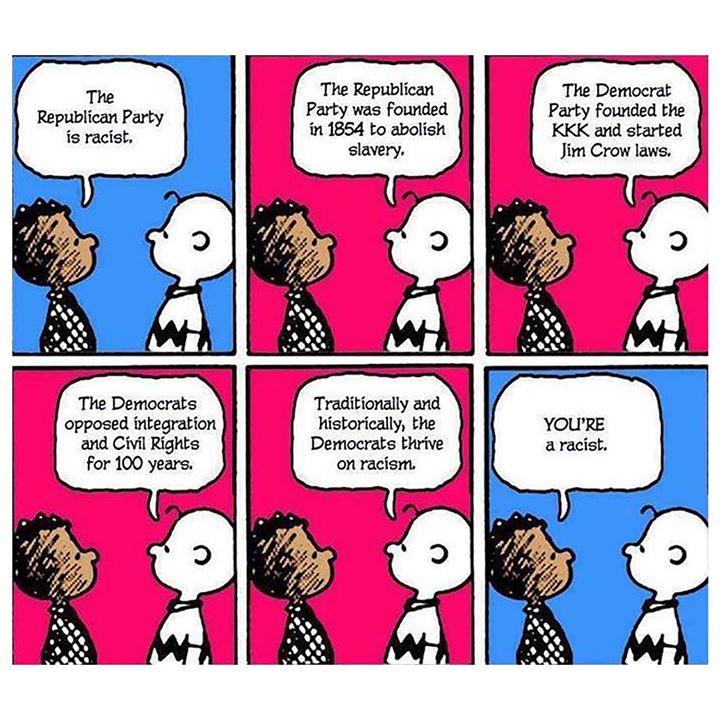
    (written in response to an insipid Facebook post by the -- thankfully -- inimitable Dinesh D'Souza, showing the idiotic comic copied above)
    “Is” is not the same as “was”.
     
    But, hey, what would you expect from a hack?
     
    I think it’s actually hilarious that defenders of the modern GOP think they can win arguments by brining up what the Republican Party was before the Southern Strategy. Sure, the GOP used to have moderates and even progressives in it, and sure, the GOP of the 1860s took some bold stands on racial equality. Moreover, the Democratic Party was home to racists, segregationists, and secessionists.
     
    Oops, there’s that key word again…”was“. Starting in the middle of the 20th Century, the Democratic Party began to take a more progressive stand and to drive out the racists, segregationists, and secessionists. Luckily for those outcasts, the other major party — that would be the Republican Party, if you’re having trouble keeping track — decided that, to score cheap electoral victory, it would happily become the new home for racists, segregationists, and secessionists. It banked on exploiting the fears and prejudices of the White majority because electoral success looked easier that way. Of course, you can’t spend 40 years pandering to the lowest ugly factors of human nature without eventually becoming tainted by them and transforming into the beast you thought you were controlling.  So here we are today, with Donald Trump nothing more than the unfiltered id of the raw sewer of racial entitlement and resentment that Richard Nixon, Kevin Phillips, and Lee Atwater tapped into.
    It must be conceded that “The Democratic Party opposed integration and Civil Rights for over 100 years”.  That puts the end of their opposition to, hmmm, let’s see, carry the one… oh, yeah, the 1960s.  Meanwhile, the Republican Party embraces racist attitudes and policies today — not fifty years ago, but today.  Really, which one are we supposed to cheer?  Proving once again that Dinesh D’Souza is an idiot.
    I am actually quite proud of the fact that I was disdaining Dinesh D’Souza back in the late 1980s, before he was a national disgrace and a widely-known joke.
  • Three thoughts on the FBI’s bite at the Apple

    Three thoughts on the FBI’s bite at the Apple

    I read a primer in Vox on the developing fight between Apple Computer and the FBI, and it spurred three distinct thoughts in me.

    The basic contention is whether Apple should be forced to disable a security feature on the phone of the San Bernadino shooter, so that the FBI can brute-force the phone without fear of it nuking itself after some number of bad guesses (10, I think, but I’m not sure).

    Firstly, the author includes the line

    The concern is that the government is trying to take advantage of a particularly odious defendant to set a precedent that could have much broader implications.

    Well, duh.  The defendants in all important civil liberties cases look like terrible people, because those are the people the state most egregiously assaults.

    Secondly, there’s a thing I don’t understand, and would love to hear from someone who knows:  To change the behavior, it seems to me, Apple would have to craft a special iOS update.  But after that, the crippled update would have to be installed.  Won’t it require knowing the passcode for that to happen?  Can Apple force an update down the pipe even to phones that are locked?  It seems to me that the request of the FBI is not only odious and an offense to the safety of citizens.  It might also be technically impossible.

    Thirdly, I am a little disappointed — assuming what I’m about to say is actually true — that the NSA or other competent agency doesn’t have the capacity to read out the non-volatile memory non-destructively somehow.  They could then run an iPhone simulator with the copied data and brute-force it.  Every time it froze or self-erased, the agency could just reboot the simulator and try again.  This would take time but then you wouldn’t need any sort of help from Apple.

    Or maybe the NSA doesn’t want to admit to having such a capacity.  🙂


  • “Morning” After Blues?

    I had the same thought as Steve Bennen when he penned A generation later, Rubio flubs ‘Morning in America’:

    Maybe the whole “morning” metaphor was a little too subtle for Marco Rubio. He’s not pitching Reagan’s message; he’s offering the literal opposite.

    The point of “Morning in America” was that things had turned a corner and were getting better under the current President at the time (Reagan).  The Gipper had vanquished darkness and we were headed into a glorious new American day.  Things would only get better.  Is that really the impression Rubio wants to make on current voters?  That Barack Obama healed our wounds and improved our standing?  (I happen to agree but it’s odd for Rubio to make that case.)

    The ad itself is appropriately apocalyptic and more in keeping with the current GOP memes.  I wonder if the Rubio campaign commissioned a more upbeat ad, then realized that Rubio as optimist wasn’t getting any traction, and thus called up the ad company and said “Make it completely different”, but all the contracts had been printed or something.

    Or maybe they just got the name wrong.  Maybe it’s a typo.  Maybe the title was supposed to be, “Morning After in America”.  Or “Morning … of DOOMSDAY in America!”

    Odd and sloppy, no matter what.  Well, at least the cognitive dissonance is getting them some free airplay, I suppose.