Well, not really. But for all of you out there breathlessly awaiting every post from The Mongrel Dogs Who Teach (yeah, right), a word of explanation. I’m in the middle of a two-week cruise to Hawai’i, and Net access is extremely limited. So I’ve not been posting. Now that I figure out how to hook up my flaky wireless card to the ship’s network, I might be able to do a better job. Or not. We’ll see.
Blog
-
Speculation on why Gonzales lied
It’s pretty clear that there’s only one reason why Alberto “Fredo” Gonzales didn’t commit perjury: Because GOP senators arranged for his March testimony to not be under oath, and an oath is required for perjury. It’s equally as clear that he lied to Congress, and he should suffer for it. But it demands we consider: Why are the AG and POTUS so concerned about the fact of dissension within DoJ about their program? It can’t be to avoid the appearance of illegality, because the President has admitted to committing repeated felonies since 9/11, in his flagrant disregard of FISA; and apparently that wasn’t enough to trigger DoJ concerns.
What had they been doing, that is so beyond the pale that the acting AG, the actual AG, the director of the FBI, and virtually the entire upper staff at DoJ were willing to resign en masse rather than stomach? This can’t be anything as prosaic as violating FISA or even just simple data mining. What was this Administration doing, that even four years later, they are so terrified of becoming public that the Attorney General is willing to debase, embarrass, and all but perjure himself?
I don’t know (sorry) but I have a pretty strong suspicion. Other than a good juicy sex scandal (and I don’t believe that’s at the heart of this, though you can never rule it out), there is only one thing that is so terrible, so unthinkable, that the merest hint it had happened could in fact rouse the notoriously soporific American public. I think that if the fact ever do come out — and, if the next Administration is a Democratic one, the facts will come out — I will be proved right by history.
Here’s my speculation:
These thugs were using the NSA to spy on Americans for the express purpose of steering the Presidential election to George W. Bush.It’s possible that this man has stolen not one election, but two. And I still have faith in America: The truth will out, and the wicked will suffer. It’s just a matter of time.
-
New Poster: Ready?
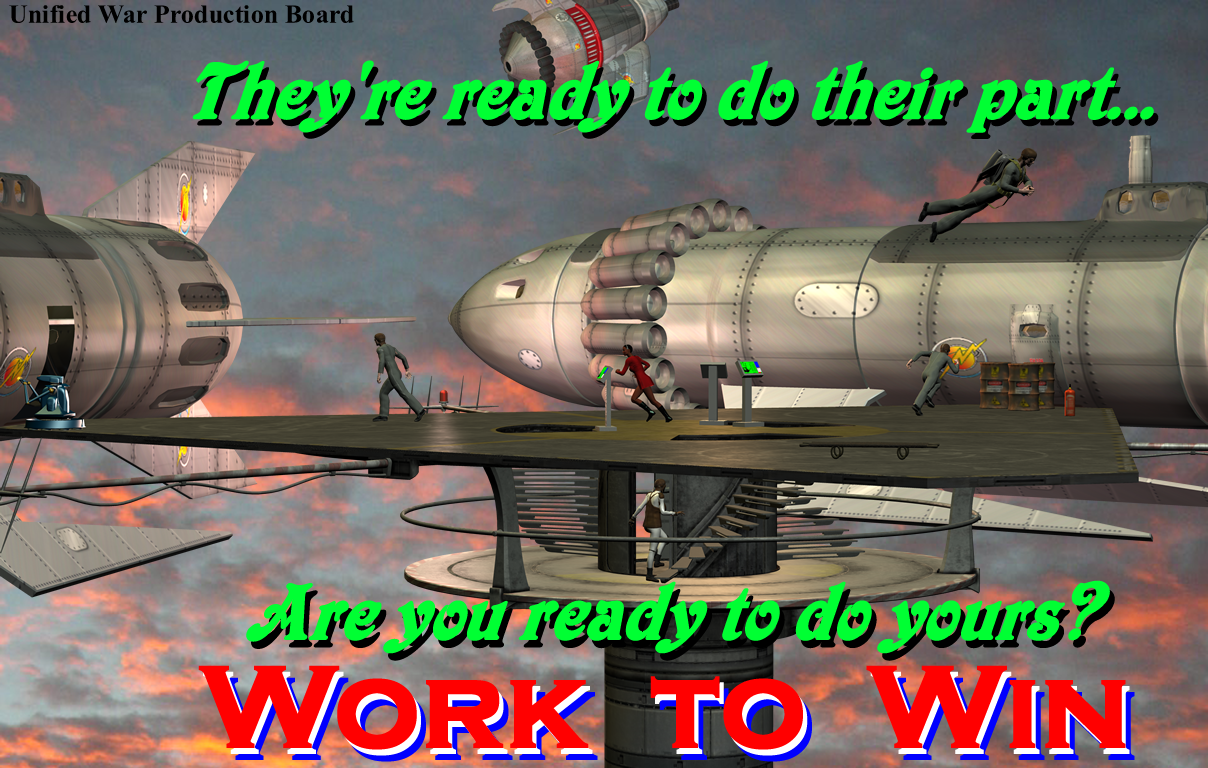
I’ve got a new, rarer “landscape” poster ready. It shows two Zarkov rockets at a docking tower, with crew running to man the ships. A DV snub fighter is lifting in the background, and the ever-lovable jetpack guy has just launched himself. The tag is “They’re Ready to Do Their Part … Are You Ready to Do Yours?“, with the ubiquitous “Work to Win” slogan. I am particularly happy with this one because it is not based on an existing poster, at least not as far as I recall. More below the fold.
-
New Poster: Loose Lips…
This is a variant of a classic saying from the Second World War: “Loose Lips Crash Ships!“. Of course, in the original, it’s “Loose Lips Sink Ships” and the image is of a cargo ship going down beneath the waves. Well, cargo ship clearly becomes rocket ship… but then I was stuck. You see, my rocket ship models are all intact. I haven’t yet mastered the art of deforming, breaking, or otherwise mangling a triangle-mesh object, so I had to work around it.
My solution? Two ships, one pointing into the ground and the other, some distance away, pointing out of the ground. The intended effect was to imply a single ship broken in twain by the crash. I also sought out some fire effects and decided on — believe it or not — a Witch-Burning set by Peemot. (I can’t find the name of the creator of the terrain piece used. Sorry.) I like to think it works but you’ll have to be the judge…

-
Health of the Republic: Down 10% to 15%
With exactly 18 months left to go in office, this President has made a sweeping and unprecedented play for unchecked power. According to a Washington Post article, the President intends to claim that Congress cannot pursue its investigation into the political firing of 9 US Attorneys, because the President has exerted a broad “executive privilege” that (he claims) exempts his former underlings from testifying. By statute, enforcement of a contempt-of-Congress citation is handled through the Department of Justice, which must convene a grand jury on the matter. According to the Bush faction, because the Justice Department is a part of the executive branch and because Bus claims that the executive branch is “unitary” (an untried and abominable constitutional theory), the DoJ cannot take action that doesn’t conform to the “will” of the President.
Let that sink in there. Our government is now to be determined by the “emanations of the will of the President” — not by, say, the laws on the books (which clearly mandate that the DoJ pursue any contempt-of-Congress charge sent to it). One scholar called the attempted power grab “almost Nixonian in its scope and breadth of interpreting its power”. It’s time to stop pussy-footing around. This makes Nixon look like a little child. Even Nixon recognized that there were some checks on Presidential power; the Bush White House feels there are none.
More below the fold.
(more…) -
“We Can’t Make It Here” — James McMurtry
Should I hate a people for the shade of their skin?
Or the shape of their eyes? Or the shape I’m in?
Should I hate them for having our jobs today?
No, I hate the men who sent the jobs away.
-
Re-cap on the posters
It’s become clear that I’ve mis-tagged some of these, and I thought it was about time — 1/3 of the way toward a book! 🙂 — to collect them in one place.
More below the fold.
(more…) -
New poster: Don’t Let That Shadow
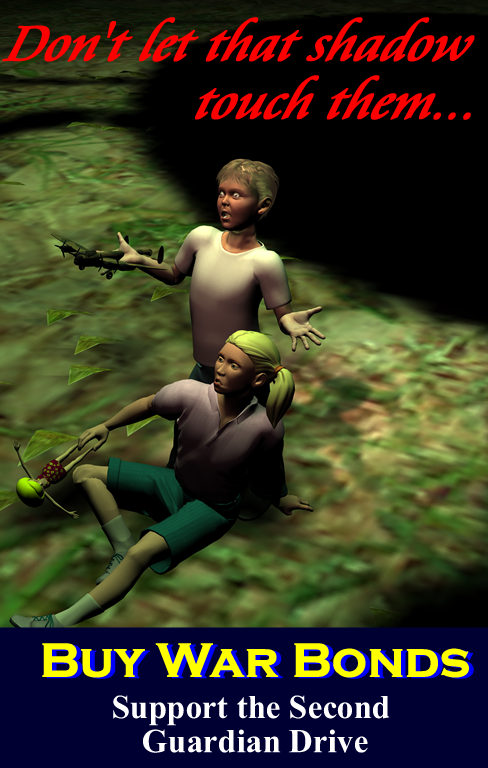
Another in the series, this one with the tag “Don’t Let That Shadow Touch Them“. This is based on one of the most effective WWII posters I know of, with the same tag but the shadow of a swastika. My job here was harder, in that I don’t have an instantly-recognizable symbol of the Martian oppressors. Instead I settled for a Martian war machine off-camera, with a low spotlight to throw a long shadow. I’m of mixed opinion on whether it gets across the shape but I like the atmosphere.
I used the Poser standard figure “Ben” plus the Poser 4 girl. For no good reason I decided on only two children instead of three. The original had the kids playing with toys, so I used a Poser-standard cartoon character “Ginger” for a discarded doll. Ben, meanwhile, holds a scale model of an Avro Lancaster bomber. Technically, this is counter-factual to my timeline, as WW II doesn’t occur in the world of IW2. But surely some further development of the airplane will occur, and the Lancaster is not a wildly unusual design.
Because most of my posters seem to exhort either “Buy War Bonds” or “Work to Win”, I decided to add something more. In this case, I mention the “Second Guardian Drive”. My nebulous assumption is that this is early in the war, when the humans are in the process of expelling the Martians from Earth. The “Guardian Drives” are bond drives to finance the outposts that will guard Earth’s orbit. This places this poster significantly earlier than, say, “Take the Fight to Them” or even “That You May Breathe Free“.

-
Shameless me-tooism
Generally, I don’t like posting a simple link to someone else. But today, I feel compelled, because Glenn Greenwald has done such a masterful job outlining the facts and the reasons behind the catastrophic collapse of American support throughout the world. We’ve allowed this President and his cronies to change what America is, and we’ve allowed him to taint how the world views us. And whether or not you take any moral guidance from the rest of humanity, you have to ask yourself this: If the “war on terror” is a globe-spanning, decade-spanning epic struggle for the survival of civilization itself … wouldn’t it be an easier fight if most of the world was on our side? Why would you go out and deliberately antagonize potential allies?
The only answer I can see is: You’d do that if you were infected with hyper-machismo that views alliances as “soft” and “weak” — the sort of testosterone poisoning that follows naturally when one feels subconscious but unavoidable guilt over dodging an earlier war’s call to service.
-
New Poster: A Swell Rocket
Yet more in my one-man propaganda barrage for the Second Interworld War. This one reads, “It’s a Swell Rocket … Send Us More! with the ubiquitous exhortation, “Work to Win”. I modeled it on one from Design for Victory that had a somewhat-goofy airman pointing his thumb at an off-camera airplane and saying, “She’s a swell plane”. Normally I’d claim the moral high ground and insist that I changed to the gender-neutral “it” rather than “she” to help stamp out sexism, but the fact of the matter is, I just didn’t notice until I was done. Then I was too lazy to go back and change it. I also included the rocket, because (as I’ve said before), I labor under the added handicap that my audience doesn’t actually have day-to-day experience with the things I’m illustrating.