There are so many different worlds
So many different suns
And we have just one world
But we live in different ones…
There are so many different worlds
So many different suns
And we have just one world
But we live in different ones…
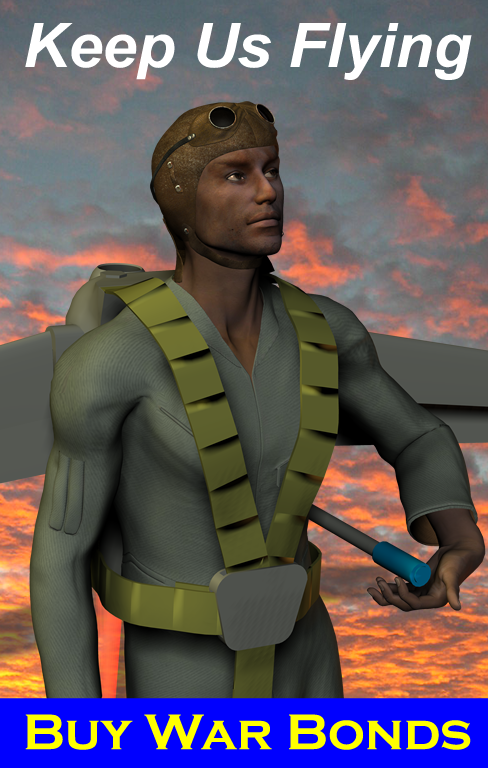
Another in the ongoing series. This one reads “Keep Us Flying — Buy War Bonds“. The inspiration is a WWII poster with exactly the same wording. In the original, it’s a pilot wearing a parachute harness. (I’m assuming it’s a pilot. It could be an airborne infantryman, I suppose.) Using the by-now standard substitution, I put in a jetpack trooper. Exhorting people to buy war bonds is pretty much the major focus of war posters, apparently.
I made one change. I didn’t like the blank background, so I scoured the Net for a free background I could use. (I found a site called stock.xchg, which has thousands of stock images [get it?], many of which are free to use.) I settled on a stirring sunrise sky, which I like quite a bit actually.
OK, first off, what the President did — commuting Libby’s sentence so that he serves no jail time — is itself well within the law. Perhaps unwisely, the Founders did vest that power in the President and he gets to use it, even when it’s unseemly. Let’s leave that aside.
But if the President thinks Libby has been mistreated, why only commute the sentence? Why not pardon him outright? In the next few days, I predict you’ll see an apparent division in the rightwing noise machine. Don’t fall for it — it’s a sham. More below the fold.
(more…)
Edited for grammar 2007 Dec 16.
I just finished watching my TiVo’d copy of “What Kind of Day Has It Been”, the 22nd and final episode of Aaron Sorkin’s Studio 60 on the Sunset Strip. Studio 60 was highly touted as the Next Big Thing in TV drama, opened with a stellar pilot, and then faded out over the course of a season. A while back, NBC made it clear that it would not be picked up for a second season; the word was out early enough for Sorkin to adjust the storylines for the last few episodes.
Short version: Like most of the post-hiatus episodes, this one was pretty good. It had flashes, at least, of the brilliance that Sorkin brought to Sports Night and of course The West Wing. Much like the rest of the season, alas, it had only flashes. The episode was bittersweet, in that you can see where this might have gone with another season’s chance. There really was potential for a break-out, smart, important TV show, but Sorkin never quite found his feet.
More below the fold.
(more…)
Today, there’s a piece by Maya Jasonoff in the Sunday magazine of the New York Times on the Americans loyal to Britain during the Revolution, and it has me irked. It’s not the thesis, which I agree with, that we should be more aware that the “self-evident” truths were anything but, to about 20% of the population. It’s not the timing, the seemingly-obligatory article near July 4 warning us that it wasn’t all fireworks and oratory. That’s a useful exercise, too, especially in an age of unquestionable jingoism. No, what has me irked is the following statement:
Yet in all, more than 700 people put their names to the parchment — 12 times the number who signed the Declaration of Independence.
“The parchment” referenced here was a petition by the royalist Americans to their king, declaring their loyalty and dismay at the Revolution. Despite the inherent strength of her arguments, Ms. Jasonoff appears compelled (by insecurity?) to puff up the popularity of the Tory case by a specious popularity contest. She must know better: The Declaration was signed by members “in Congress assembled”; it was not an invitational and the grouping was by design small in number. To compare it to an open petition left out in a New York tavern for three days, is simply absurd. How many roaring patriots would have signed the Declaration (had it be a petition) is unknowable but certainly vast… more vast than 700, if one can judge by how rapidly and how widely it was reproduced.
Ms. Jasonoff’s editorial choice doesn’t really undercut the article and in some ways it’s a tiny thing. But it’s another example of a growing carelessness we display with our rhetoric, a growing willingness to compare apples to oranges and act as if the comparison meant anything. It’s intellectually sloppy.
Interestingly, that’s not how the right-wing noise machine is approaching this story, about how some of the indictments against Tom DeLay have been thrown out. You’d think that people who have spent literally four decades decrying “judicial activism” and unjust outcomes of people “clearly” guilty, would be a-twitter that a judge and then an appeals court threw out the indictments on a technical point.
In fact, however, people at, say, the National Review think this post-facto justifies Mr. DeLay and makes it almost criminal that he was forced to step down as House Majority Leader. We should all cry for Mr. DeLay, apparently. Except of course — as even the more-friendly Houston Chronicle article is forced to admit — Mr. DeLay still faces charges of laundering money and of committing conspiracy to launder money. Those were crimes at the time (Illegal to launder money? Who knew?) — and he may still face trial on them.
The guys at the National Review take this as evidence that “the charges seem to be falling apart”, but that seems a tad over-optimistic based on the articles I’ve seen. The dismissal came because the crime Mr. DeLay was alleged to have committed didn’t come into force until 2003, whereas his disreputable actions happened in 2002 and before. It seems the courts had little choice on this one — though I’d love to know what prosecutor Ron Erle had in mind when he pressed the charges in the first place. I doubt this is as open-and-shut as it seems. All that notwithstanding, the other charges are not hobbled by the same calendar problem. Money laundering and conspiracy have been on the books as crimes for quite some time now.
Though the Review article would have you believe that the dismissals taint the other indictments, in fact, the only reason that Mr. DeLay has not faced trial yet is that the presiding judge opted to wait until the appeal of indictments was complete.
Has “the Hammer” been vindicated? Hardly.
Yet another in the series of posters for the newly-rechristened Second Interworld War. This one is inspired by the many different posters that had streams of planes passing overhead in a not-too-subtle V formation. The purpose was to impress with the sheer excess of Allied production. And of course, the exhortation to work hard and to invest in war bonds. My poster reads “Give them the Tools of Victory: Work to Win”.
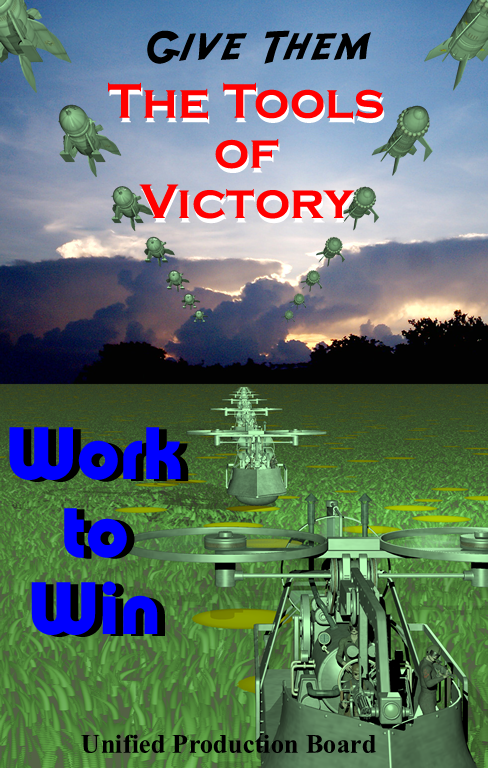
Executing this poster took quite a bit more work than the others; the gruesome details appear below the fold.
(more…)
I’ve been making posters that, I’ve claimed, were from the First Interworld War. I’ve decided that, “really”, they’re from the Second Interworld War. The primary motivation for the change has been the realization that most of my inspirations are from WWII, not WWI. Also, this allows me to imagine, vaguely, that H.G. Well’s War of the Worlds was the First Interworld War. Here’s what I envision:
Wells’ Martians apparently did not have radio technology. It seems a pretty big lack, but who knows? Mars does not have a Heaviside layer, I believe, so the idea of long-distance transmission by radio might not have occurred to them. Also, there are signs that Well’s Martians were telepathic. If so, and if telepathy is not easily conveyed by electromagnetic fields, then they might never have gotten into that technology. If telepathy is then also short-ranged, we’d have the situation I want; to wit, that the Martians dying on Earth are unable to relay a warning about infection to the Martians at home. Since the Martians (justifiably) probably found it inconceivable that we resist their might, they might have kept chucking one or two cylinders a year as reinforcements, not knowing at first that the war was lost and later, not knowing why.
So, for the next decade or two, at random times spaced by a few months, these engines of death would come down on Earth. The Martian within would extricate the walking machine, lay waste to the surrounding area, but then eventually die from the same disease that brought down the first. Along the way, the powers on Earth would get valuable experience and technology battling the lander and then trying to recover it. This allows me to leapfrog tech when I need to, and explains the follow-up.
More below the fold.
(more…)
More from the First Interworld War. One is an updated version of my very first Interworld War poster. The second has the tagline “See Action Now … Join the Rocket Service.”
My reasoning, and the actual posters, below the fold.
What is so seductive about the end of the world?
Evidence of the eschatonic impulse are around us everywhere. Disaster movies often reign supreme in the theaters — and the bigger the disaster (Independence Day, Armageddon, etc.) the more successful the movie. Foreign policy seems more and more a push for one last throw of the dice. Preachers orate, as they always have, of the coming of hellfire. Books like Left Behind are runaway best-sellers.
Why is it that we are drawn to the end of the world? More below the fold.